Calgary, Alberta · City guide
Poly-B Replacement Services in Calgary
How common polybutylene plumbing is across Calgary, what the City’s own records say about your community, and what replacement, permits and insurance involve here.
Calgary’s Poly-B Challenge
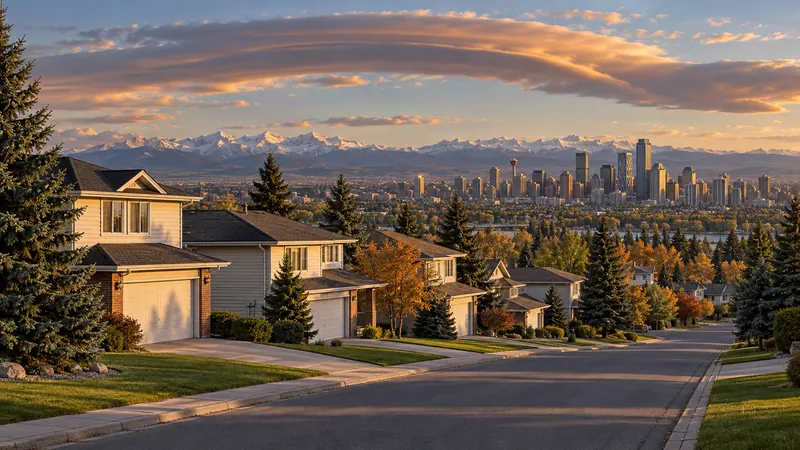
Calgary did much of its growing in exactly the years poly-B was being installed. The City’s assessment roll dates 131,644 of its 502,334 residential properties (26.2%) to 1978–1998,2 and a 2025 release from a Calgary replacement firm claims the city has the highest density of poly-B relative to its market size in Canada.11 The Alberta REALTORS® Association puts the material’s widest use at 1985–1997.9
Whole communities were built almost entirely inside that window, among them Sundance, Woodbine, Falconridge, Sandstone Valley and Beddington Heights. A build year is a reason to look, not proof: only the pipe itself confirms poly-B.
Calgary by the numbers
Build era
Why Calgary Homes Are Affected
A growth spurt that lined up with poly-B. Today’s assessment roll records 76,300 homes from the 1970s, 51,445 from the 1980s and 68,026 from the 1990s, so the two poly-B decades account for close to a quarter of all residential properties in the city.2 The 2021 Census counts it from the households’ side and lands in the same place: 59,780 occupied dwellings from 1981–1990 and 75,685 from 1991–2000.1 Provincial guidance says poly-B reached Alberta builders in the mid-1970s and that a house built before 1975 would only have it if the plumbing had been renovated since.10
Where that housing sits. In its community district data the City labels 31 communities as “1980s/1990s” communities. Ten of them are in the South sector, including Sundance, Woodbine, Deer Run and Deer Ridge; the rest are spread across the North, Northwest, West, Southeast, Northeast and East.4 Assessment records push the list further, because several communities the City files under other decades were still being built out after 1978.
High-exposure communities, by the numbers: Sundance (99.7% of residential properties built 1978–1998), Woodbine (99.5%), Castleridge (98.7%), Falconridge (98.5%), Sandstone Valley (98.1%), Deer Run (97.8%), Deer Ridge (96.0%), Beddington Heights (95.8%), Scenic Acres (95.7%), Temple (88.4%) and Monterey Park (86.9%).2
Two names that need a correction. Marlborough and Huntington Hills are often listed with the northeast poly-B communities, but most of their homes are older: just 5.7% and 8.6% carry a 1978–1998 build year, and the median years are 1972 and 1971.2 Rundle is also a 1960s/1970s community in the City’s classification.4 Houses there can still hide poly-B from a later renovation, so check the pipe instead of relying on the street.
Calgary communities with the highest share built 1978–1998
Communities with at least 1,000 residential properties on the City’s assessment roll, ranked by the share with a 1978–1998 construction year.
| Community | Residential properties | Built 1978–1998 | Share | Median build year | Plumbing improvement permits since 2018 |
|---|---|---|---|---|---|
| Sundance | 3,209 | 3,198 | 99.7% | 1988 | 449 |
| Woodbine | 3,343 | 3,326 | 99.5% | 1981 | 265 |
| Castleridge | 1,678 | 1,657 | 98.7% | 1981 | 75 |
| Falconridge | 2,924 | 2,881 | 98.5% | 1981 | 163 |
| Sandstone Valley | 2,107 | 2,068 | 98.1% | 1989 | 184 |
| Deer Run | 2,099 | 2,053 | 97.8% | 1981 | 108 |
| Deer Ridge | 1,394 | 1,338 | 96.0% | 1981 | 65 |
| Beddington Heights | 4,280 | 4,101 | 95.8% | 1980 | 210 |
| Scenic Acres | 2,907 | 2,782 | 95.7% | 1991 | 352 |
| Abbeydale | 1,838 | 1,693 | 92.1% | 1980 | 68 |
| Edgemont | 5,317 | 4,875 | 91.7% | 1987 | 406 |
| McKenzie Lake | 4,582 | 4,104 | 89.6% | 1995 | 560 |
Sources: City of Calgary assessment roll2 and plumbing permit data.3 Each condominium unit is its own assessment account. Permit counts cover every plumbing improvement permit in the community since 2018, not only poly-B work.
Water utility
Calgary’s Water Chemistry
Calgary draws its drinking water from two rivers. The Bearspaw plant takes water from the Bearspaw Reservoir on the Bow, and the Glenmore plant from the Glenmore Reservoir, which the Elbow feeds.6 Both use chlorine: sodium hypochlorite goes into the clarified-water basin, and a second dose is added before water leaves the plant, a step the City calls post-chlorination.6 Its water quality summary reports a free chlorine residual of 0.82 to 2.01 mg/L.7
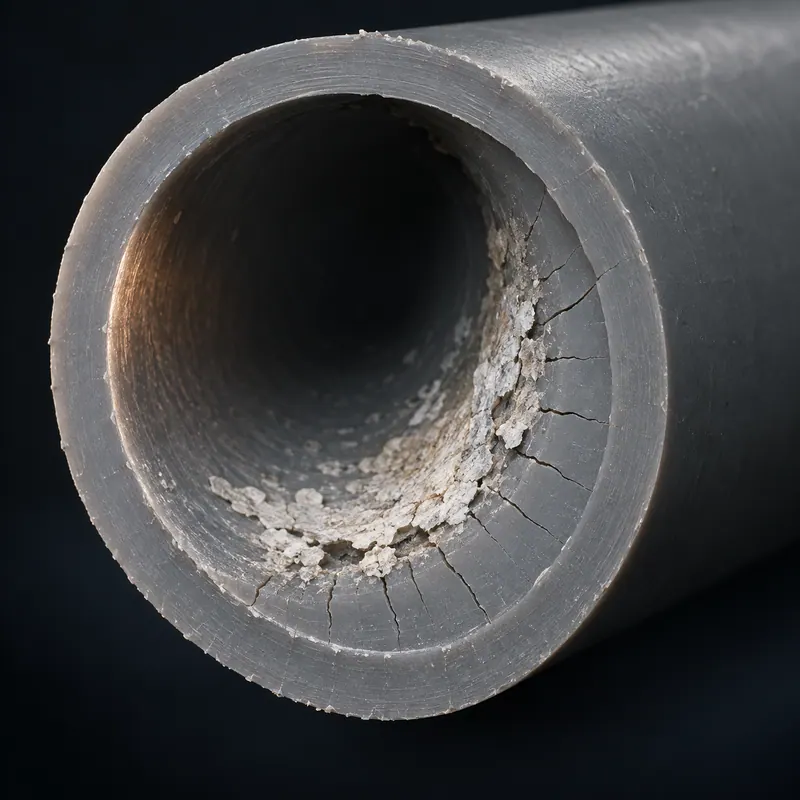
That matters because chlorine is one of the things polybutylene handles badly. The Insurance Bureau of Canada lists poly-B’s reactivity with chlorine in water among the reasons it breaks,18 and an engineering bulletin from broker BFL Canada explains that the degradation starts on the inside wall, so a weakened pipe can look normal from outside.20 No published source says Calgary’s chlorine level is unusual. This is routine municipal treatment acting on an ageing material.
The water is also hard. The City attributes that to calcium and magnesium from the Bow and Elbow, and its 2025 ranges run from 141–200 mg/L (as calcium carbonate) at Bearspaw to 181–274 mg/L at Glenmore, with the hardest water between December and February.7 Renovation writer Jon Eakes, who began hearing about Calgary poly-B failures in 2010, suggests mineral deposits in bends may add wear through turbulence. Treat that as a field observation, not a tested finding.19
Pressure
Water pressure: the Calgary factor people overlook
Calgary spans an elevation range of almost 300 metres, so the utility divides the system into pressure zones and fits valves where pressure starts to exceed 70 metres of head, about 100 psi.8 Inside the house, the City says homes built after 1990 in areas above 80 psi are equipped with a pressure-reducing valve, and that a valve over five years old may need service.8 A house from the early or mid-1980s may never have had one.
For poly-B the comfortable number is lower than many homes see. BFL Canada recommends operating poly-B systems below 60 psi and at water temperatures of 55–60 °C to slow the damage, while noting it cannot prevent eventual failure.20 Eakes warns that weak pipe can blow apart above 80 psi and points out that Calgary runs many pressure booster stations.19
A screw-on pressure gauge at the laundry or hose tap gives you a reading in a minute. If it is high, ask a plumber to install or service a pressure-reducing valve. Treat it as a way to buy time until the pipe is replaced, not as a repair.
Calgary Replacement Costs
Prices published for Calgary by the businesses named, accessed in September 2026. None is a HAUSE quote, and the scopes differ: some include drywall and paint, others stop at the plumbing.
| Published by | Range | What it covers |
|---|---|---|
| Lone Star Plumbing & Heating12 | $5,000–$15,000 | Its usual average for a poly-B replacement |
| ATCO Energy home services13 | $5,000–$15,000 or more | Re-piping a home; expect a few days to a week or more |
| Urban Piping, plumbing only14 | $5,000–$8,000 + GST | Access holes cut; drywall restoration left to the owner |
| Urban Piping, with drywall hand-off14 | $8,000–$12,000 + GST | Plumbing plus an estimate from a partner drywall firm |
| Urban Piping, complete14 | $10,000–$15,000 + GST | Plumbing, drywall and painting |
| Urban Piping repiping guide15 | $5,500–$12,000 | Calgary and Edmonton full-home repipes of any pipe type |
Contractor figures are marketing estimates, not audited prices. Run your own numbers in the cost calculator.
What moves a Calgary quote
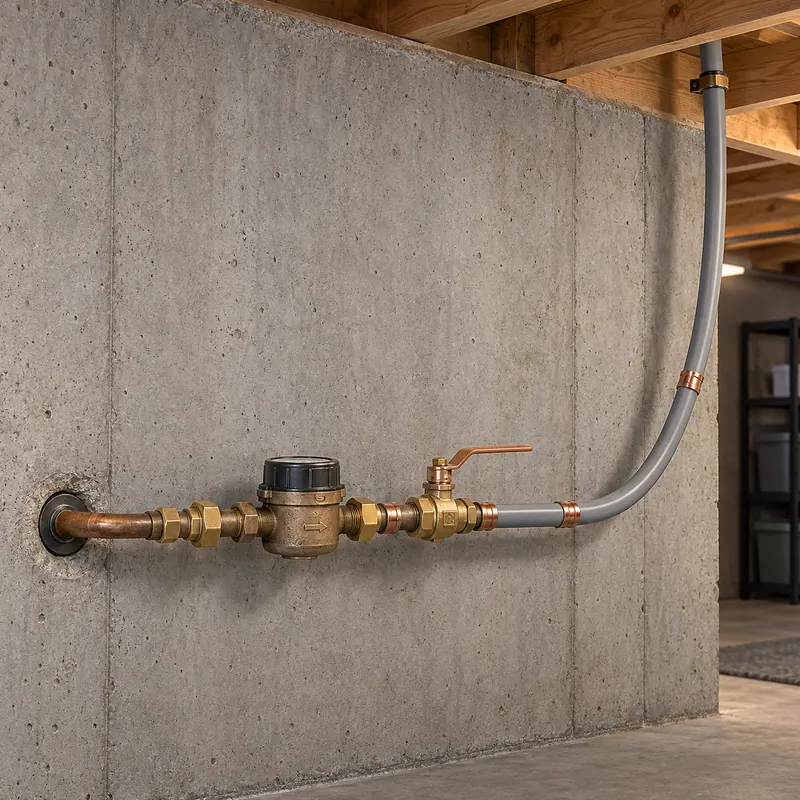
Basements are the reason Prairie repipes often cost less than coastal ones. Square One Insurance notes that pipes are easier to reach in a home with a basement, which is why replacement is often cheaper in the Prairie provinces than on the west coast.22 An unfinished basement ceiling in a Calgary two-storey is close to the ideal: long runs are open to view, and the new lines can follow the joists before rising to each bathroom.
The things that push a quote up are the ones you can see from the hallway. A finished basement ceiling has to be opened and patched, every extra bathroom adds pipe and connections, and copper costs more per foot than PEX before any labour is counted.15 Urban Piping’s repiping guide puts labour at 50 to 60 percent of a typical job,15 so compare how many working days each quote allows, not only the material.
Ask every contractor the same questions: is the permit included, who patches and paints, is the water back on each evening, and will the quote change if more poly-B turns up behind a wall. The answers make quotes comparable.
Permits and inspections for a Calgary repipe
What the City of Calgary requires, in the order it happens.
A permit is required
The City requires a plumbing permit whenever a plumbing system is constructed, extended or altered, and names replacing the water lines in or around a home as one of the cases.5
The person doing the work holds it
A homeowner permit is only for owners who live in the house, not a rental, and do the work themselves; if you hire a contractor, the contractor applies.5 Alberta treats plumbing as a certified trade, so the work needs a recognized certificate holder or a registered apprentice.21
Rough-in inspection
The City’s checklist has the new water lines installed, connected to the rest of the distribution system and properly supported before the rough-in visit.5 Book drywall repair for after this inspection, not before.
Final inspection
Fixtures must be ready for use, every toilet needs a shut-off valve, and bathtub and shower water must not exceed 49 °C.5 Keep the permit number and the final result with your invoices.
The paper trail
Calgary publishes its permits as open data: 51,136 plumbing improvement permits have been issued since January 2018, 8,022 of them in 2025.3 The records carry no job description, so they cannot say how many were poly-B replacements.
Alberta insurance
Insurance Considerations in Calgary
Alberta insurers ask about poly-B, and the answer shapes the offer. A national brokerage lists four responses an insurer may give: a surcharge on the premium, a deadline to replace the pipe, no coverage for water damage, or no property coverage at all.16 One Alberta broker says a poly-B home typically needs a certified plumbing inspection before it can be insured.17 The Alberta REALTORS® Association adds that some insurers allow time to replace if flood detection or automatic shut-off valves are installed.9
Urban Piping, a Calgary replacement contractor, states that Intact, Aviva, Co-operators, TD Insurance and Wawanesa now require complete removal within 12 to 24 months or will not renew.14 That is a contractor’s claim. None of those insurers publishes a poly-B rule we could find, so ask your own insurer for its position in writing.
- Answer poly-B questions on any application accurately and keep a copy
- Photograph the pipe and keep any inspection report
- If you are given a replacement deadline, ask whether a leak-detection or shut-off device changes it
- After replacement, send the invoice and permit record to your insurer
The insurance guide compares what Canadian insurers and brokers say.
Buying, selling or owning a condo in Calgary
The Alberta REALTORS® Association treats poly-B found at a showing as one more point of negotiation rather than a deal-breaker. Its advice to buyers is a condition in the offer that leaves time for professional advice and several replacement quotes.9 Call an insurer before that condition expires, since the insurance answer can change the budget more than the plumbing does.
Sellers who have already replaced the pipe should gather the invoice, the permit number and the final inspection result; that bundle answers the questions an inspector, a buyer and an insurer will each ask. Sellers who have not can still get a quote in advance, so the conversation starts from a real number.
In the assessment roll every condominium unit is a separate account,2 so the community counts above include condo townhouses and apartments. If you own a unit, ask the board or property manager who is responsible for the supply lines inside your walls, and whether the corporation plans to repipe the whole complex, before you book any work.
Calgary community guides
- All Calgary communitiesSearch every community guide and sort by share of homes built 1978–1998
- Sundance99.7% built 1978–1998 · median year 1988
- Woodbine99.5% · median 1981
- Castleridge98.7% · median 1981
- Falconridge98.5% · median 1981
- Sandstone Valley98.1% · median 1989
- Beddington Heights95.8% · median 1980
- Scenic Acres95.7% · median 1991
- Edgemont4,875 homes in the window, the most of any community
- Monterey Park86.9% · median 1994
- Signal Hill76.4% · median 1995
HAUSE desk · Request
Get Replacement Quote
Tell us about your Calgary home: the community, the size, how many bathrooms and whether the basement is finished. A person on the HAUSE desk replies with next steps and, where available and with your consent, a local replacement contractor who can quote.
- 01A person reads itThe HAUSE desk reviews the age of the home, what you found and how urgent it is.
- 02You get a replyBy email from info@hause.ca or by phone from 403-679-3100, with practical next steps.
- 03Matched where availableWith your consent, your request goes to a local replacement contractor so they can quote.
- 04You decideNo obligation. Use the guides and the cost calculator to compare what you are quoted.
Questions · 6
Frequently asked questions
How do I know if my Calgary home has poly-B?
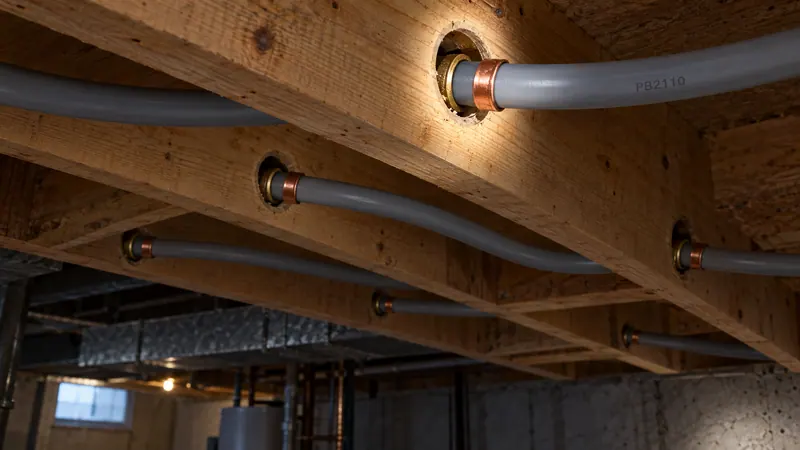
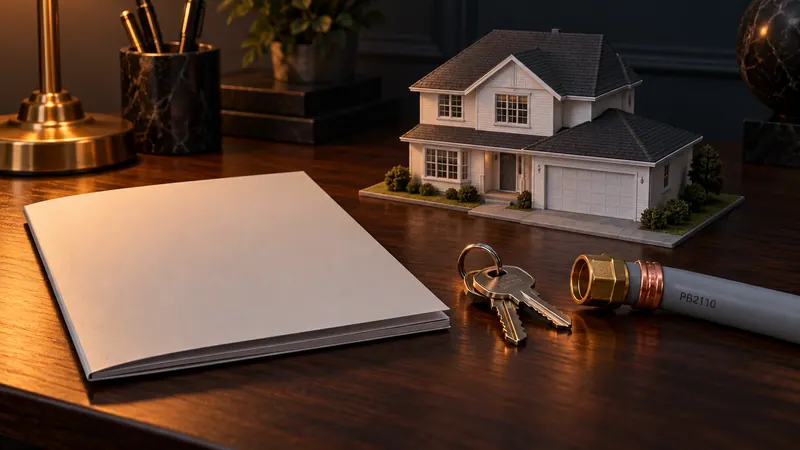
Start with the build year, which appears in the City’s assessment data; homes from 1978 to 1998 are the ones to check.2 Then find an exposed supply pipe in the utility room or above a basement drop ceiling. Grey plastic with copper or brass fittings is the usual sign, and the print on the pipe often reads PB2110.129 A plumber or home inspector can confirm it and tell you how much of the house it serves; see the identification guide for a room-by-room walkthrough.
What neighbourhoods in Calgary are most affected?
By the City’s assessment records, the communities with the highest share of homes built 1978–1998 include Sundance, Woodbine, Castleridge, Falconridge, Sandstone Valley, Deer Run, Deer Ridge, Beddington Heights and Scenic Acres, all above 95%.2 Edgemont, McKenzie Lake, Signal Hill and Douglasdale/Glen each have more than 3,700 homes in the window. Marlborough and Huntington Hills were mostly built before 1978.
How long does replacement take in Calgary?
ATCO Energy says to expect anywhere from a few days to a week or more,13 and Urban Piping’s repiping guide puts most single-family homes at three to seven business days including restoration.15 Plumbing is the shorter part; drywall, texture and paint take longer. Ask whether water is restored at the end of each day.
Does Calgary’s cold climate affect poly-B differently?
No source we found links Calgary’s winters to a higher poly-B failure rate. Pipes inside heated space do not see outdoor temperatures; cold matters where a line runs along an exterior wall, a garage or a crawl space, as it would for any material. The factors with better support are chlorine, hot water and pressure.1820 The City notes that a gradual drop in pressure in winter can signal a frozen water line.8
Do I need a permit to replace poly-B in Calgary?
Yes. The City requires a plumbing permit when water lines in or around a home are replaced, with a rough-in and a final inspection.5 If you hire a contractor, the contractor takes out the permit; a homeowner permit is only for owners doing their own work in a house they live in. The homeowner permit costs $116.50 including the Safety Codes Council fee.5
Will a pressure-reducing valve protect my poly-B?
It can slow wear but will not stop it. BFL Canada recommends keeping poly-B systems below 60 psi,20 and the City says homes built after 1990 in areas above 80 psi have a pressure-reducing valve, which may need service once it is more than five years old.8 Check your pressure with a gauge, then plan replacement anyway.
Sources
- Statistics Canada — 2021 Census Profile (98-316-X2021001): occupied private dwellings by period of construction, Calgary · accessed 2026-09-28
- City of Calgary Open Data — Current Year Property Assessments (Parcel), residential accounts by year of construction · accessed 2026-09-28
- City of Calgary Open Data — Plumbing Permits and Inspections · accessed 2026-09-28
- City of Calgary Open Data — Community District Boundaries (community structure classification) · accessed 2026-09-28
- City of Calgary — Homeowner electrical and plumbing permits · accessed 2026-09-28
- City of Calgary — The water treatment process (online tour) · accessed 2026-09-28
- City of Calgary — Water quality, water hardness and water data · accessed 2026-09-28
- City of Calgary — Water pressure in Calgary · accessed 2026-09-28
- Alberta REALTORS® Association — What should I know about Poly-B piping in homes? (Bryan Statt, 16 January 2025) · accessed 2026-09-28
- Government of Alberta, Municipal Affairs — Safety Tips: Polybutylene (Poly-B) Pressure Water Piping (reviewed August 2016) · accessed 2026-09-28
- Urban Piping via Newsfile — national poly-B replacement initiative release (2 October 2025) · accessed 2026-09-28
- Lone Star Plumbing & Heating (Calgary) — Poly B Pipe Replacement · accessed 2026-09-28
- ATCO Energy — Poly B Replacement, Alberta home services · accessed 2026-09-28
- Urban Piping — Poly B replacement in Calgary: process, packages and insurance FAQ · accessed 2026-09-28
- Urban Piping — House Repiping Cost Guide (2026) · accessed 2026-09-28
- Westland Insurance — Has your broker asked if you have Polybutylene (Poly-B) plumbing? (7 September 2023) · accessed 2026-09-28
- Armour Insurance — How to identify the type of plumbing your home uses · accessed 2026-09-28
- Insurance Bureau of Canada — Know your home’s history and the potential issues lurking within its walls (25 June 2025) · accessed 2026-09-28
- Jon Eakes — Plastic supply water pipe law suits: Poly-B, Kitec, PEX fittings · accessed 2026-09-28
- BFL Canada Risk Control Engineering — Ask an Engineer No. 17: Polybutylene Piping Systems (March 2020), hosted by CHOA · accessed 2026-09-28
- alis (Government of Alberta) — Plumber: certifications in Alberta · accessed 2026-09-28
- Square One Insurance — Poly-B plumbing: common issues, maintenance and more · accessed 2026-09-28
Keep going
Related guides
 Field guide · IdentificationThat grey pipe. Is it Poly-B?
 Repipe · Cost · OptionsReplacement Options & Cost Calculator
 Coverage · Disclosure · RenewalAsk your insurer. Keep the answer.
 Edmonton, Alberta · City guideEdmonton’s Complete Poly-B Replacement GuideAlberta · City hubPoly-B Replacement in Calgary, AB
Updated 2026-09-28