Failure modes · Risk
The outside cannot tell the whole story.
Poly-B can deteriorate inside the tube, and connections can leak. Understand the concerns, assess the actual system and turn the findings into a practical plan.
A clear exterior is not a condition report
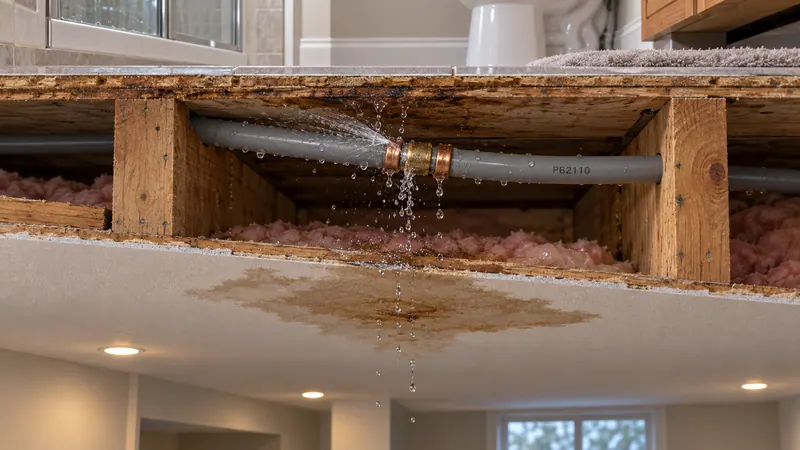
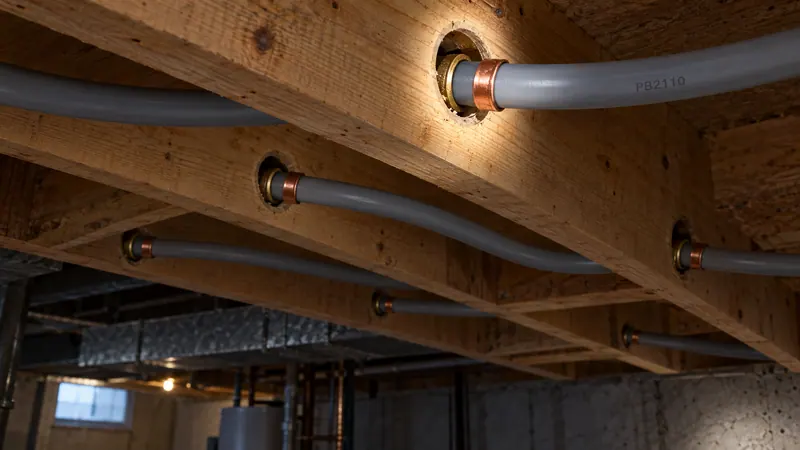
Polybutylene plumbing exposes Canadian homeowners to sudden leaks, water damage, insurance complications and friction when selling. The damage builds on the inside wall of the pipe, so a line can be seriously weakened while its outer surface looks normal.1 Most of the pipe is hidden in walls and ceilings, which makes that damage hard for owners and inspectors to see.1
A risk you cannot see from the outside
Poly-B usually does not change colour or appearance as it deteriorates, so there is little early warning before a failure.2 Once the pipe is brittle enough, a small movement can split it: a sudden pressure change, a bump, or ordinary expansion as the temperature shifts.2
That is also why risk varies so much from house to house. Two homes built the same year can differ in fittings, water temperature, pressure and installation quality, and each of those changes how fast the pipe ages. The lab below lets you see how the main factors combine.
Illustrative degradation lab
Degradation lab: heat, disinfectant and time
Set the water temperature, disinfectant level and years in service, then watch the pipe wall and a crimp fitting respond. Directions follow published research; speeds are illustrative.
What the model shows, in words
What you can change
Three sliders set the conditions: water temperature from cold supply up to a hot line leaving the water heater, disinfectant level from none to high, and years in service from new to more than four decades. A pressure switch adds a high-pressure household, and a fitting switch swaps a copper insert for an early acetal one. As you move them, the lab redraws a slice of pipe wall and a crimp joint so you can compare conditions side by side.
The pipe-wall cross-section
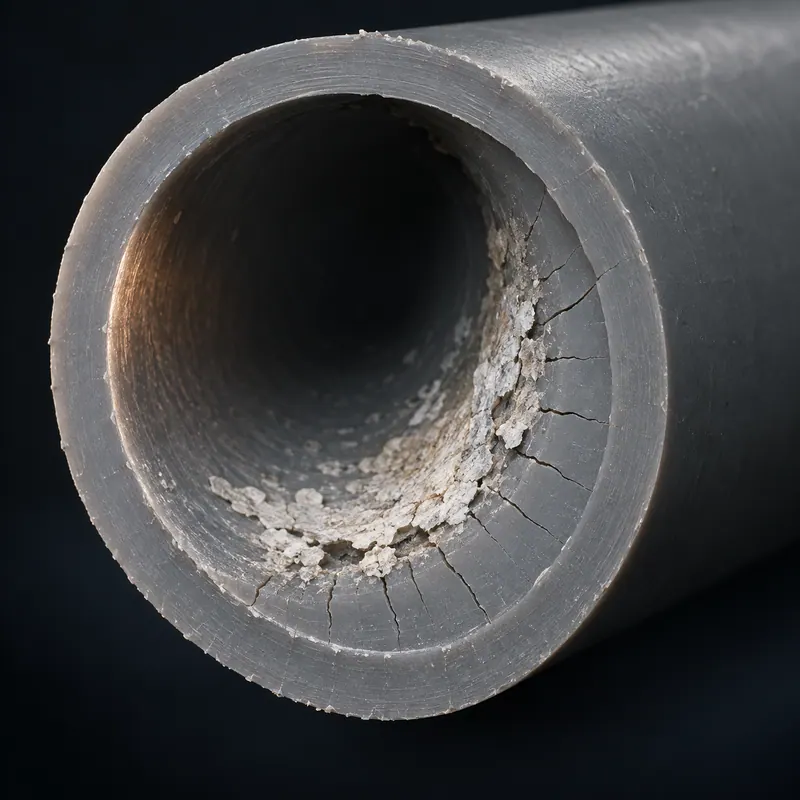
The ring in the centre is a slice through the pipe. A pale band on its inner surface stands for the antioxidant stabiliser that protects the plastic. With hotter water and more disinfectant the band thins faster, and once it is gone the inner skin darkens and fine cracks start at the bore. The cracks grow outward with time and pressure, while the outer surface stays clean until a crack breaks through. That is the pattern risk engineers describe for real poly-B.
The fitting under stress
The second panel shows a crimp joint. The tube is stretched over the insert and squeezed by the ring, so stress collects at the shoulder of the fitting. Toggle over-crimping and the squeeze tightens; switch to an acetal insert and the fitting itself starts to weaken in chlorinated water. The gauge beside it shows relative stress, which is why fittings and tight bends are the usual places a tired system gives way.
Why the numbers are illustrative
The lab follows the directions reported in published work: chlorine and heat speed the loss of stabiliser, pressure adds to it, and sunlight and poor installation make matters worse. It does not use a validated lifetime equation, because none exists for your particular pipe. The years it shows are for comparison only. Canadian tap water generally carries less chlorine than some American supplies, so the default setting is moderate.
Using the result
Green, amber and red describe the illustrative model, not the condition of your home. The sliders explain how conditions may contribute to deterioration; they do not establish failure probability, a remaining lifespan or the order in which your actual pipes will leak. Use what you learn to ask a plumber about pressure, temperature, fittings and the extent of the system.
Types of Failures
Poly-B tends to fail in three ways. Each one damages a home differently.
Sudden Ruptures
The most dramatic and damaging failure mode. A brittle line can split without warning and release water at full supply pressure until someone closes the main valve.2
Real-world consequences:
- Flooding of multiple rooms or entire floors
- Damage to drywall, flooring and structural elements
- Destruction of personal property and furnishings
- Potential mould growth if not dried out quickly
Pinhole Leaks
Small perforations that develop gradually and can go unnoticed for weeks or months inside a wall or ceiling. One replacement company describes pinholes as the usual way ageing poly-B shows itself.16
Hidden dangers:
- Slow water damage behind walls and under floors
- Damp conditions that favour mould and mildew
- Damage to wood framing and supports
- A gradual rise in water use that is easy to miss
Failure mode 1
Oxidation from the inside
The main way the pipe itself fails is oxidation. Disinfectant and oxygen in the water attack the polymer, first using up the antioxidant stabilisers in the inner surface and then breaking the polymer chains, until the inside of the wall turns brittle and cracks.9 The what-is page explains the chemistry.
Heat and disinfectant together are the strongest accelerators. Researchers ageing polybutylene pipe in chlorinated water at 80 °C recorded falling oxidation resistance and mechanical properties over time, and pipe under pressure lost more of its stabiliser than pipe without it.8 In a house, that combination is found in the hot lines nearest the water heater.
Most published testing uses chlorine. Some Canadian utilities disinfect with chloramine instead; ask your water utility which one reaches your tap, and treat either as a reason to watch your hot lines most closely.
Failure modes 2 to 6
Other ways poly-B systems fail
Fittings. Early grey fittings were polyacetal (POM), which degraded quickly in hot chlorinated water, lost ductility and cracked. Makers switched to copper and brass fittings, which cut failures but did not end them.10 Alberta reports that plastic inserts with aluminum bands were more prone to leaks than the metal inserts with copper rings used in most Alberta homes.12
Crimp rings and over-crimping. Squeezing a ring too hard on a thin-walled connection can create micro-cracks that open years later.1 Rings that were never fully crimped, or that were made for a different pipe, are also a problem, because PEX and poly-B rings are not interchangeable.11
Heat near water heaters and vents. Heat speeds oxidation. One British Columbia home inspector advises keeping poly-B 18 in (about 45 cm) from a water heater and 6 in (about 15 cm) from a single-wall gas vent connector.14 The 1995 National Plumbing Code kept poly-B out of continuously circulating hot water lines altogether.19
Sunlight. Ultraviolet light breaks polybutylene down. One Calgary plumber notes that pipe stored outdoors before installation may have had a shorter life from the start.15 Exposed runs near basement windows deserve a look.
Installation damage. The Plastics Pipe Institute lists kinking, gouges and cuts among installation errors behind some tubing failures.10 Tight unsupported bends are another; the 1995 code required horizontal runs to be supported at least every metre with hangers that did not cut or compress the pipe.19
High pressure and hard water. Pressure keeps a weakened wall under constant load. BC Housing advises a pressure-reducing valve when supply pressure exceeds 80 psi.4 Jon Eakes points to Calgary as an area with both booster-pumped high pressure and hard water that can leave deposits inside curves.13
Warning signs worth acting on
None of these proves a failure is coming, but each is a reason to call a plumber sooner rather than later.
0 of 8 checked
A ten-minute leak test with your water meter
BC Housing describes a simple check anyone with a meter can do. Turn off every faucet and water-using appliance but leave the main valve open, then watch the meter. If it keeps moving, there is probably a fast leak somewhere. If it does not, avoid using water for a few hours and check again; any increase points to a slow leak.4
A slow leak inside a wall is exactly the failure poly-B tends to hide, so repeat the test every few months and after any repair. Tracking monthly use on your utility bill gives a second, longer view.4
Risk Factors That Accelerate Failure
The same factors appear across Canadian government, insurance and building-science sources. Use the last column to check your own house.
| Factor | Why it matters | What you can check |
|---|---|---|
| Age and repair history | Age provides context, but does not establish remaining life. BC Housing recommends planning for ageing plumbing generally.4 | Build year, renovation dates, leaks and re-plumbing records |
| High chlorine levels | Disinfectant speeds oxidative breakdown of the polymer28 | Ask your water utility what disinfectant it uses |
| Hard water | Deposits inside curves may disturb flow and wear the pipe, per Jon Eakes13 | Scale on fixtures; whether you run a softener |
| Temperature extremes | Heat speeds degradation; temperature swings move brittle lines21 | Water heater setting and pipe near heat sources |
| High water pressure | Constant load on a weakened wall raises rupture risk41 | A gauge on an outdoor or laundry tap |
| UV exposure | Sunlight degrades exposed sections of polybutylene25 | Runs near windows or outdoors |
| Fitting type | Acetal inserts and aluminum bands failed more often than copper or brass inserts with copper rings12 | Look at the joints you can see |
| Installation stress | Kinks, gouges and tight unsupported bends concentrate stress1019 | Sagging runs, sharp bends, missing hangers |
Money
Financial Impact
Water damage. Water is one of the most expensive things that can go wrong in a house. BC Housing notes that water damage claims are the most common insurance claims for residential buildings, and Wawanesa says water-related events cause its highest number and severity of personal property losses.47 What a poly-B leak costs you depends on how long it runs, where it is, and what it soaks. Ceiling and wall repair, flooring, contents and drying all add up, and mould remediation adds more if water sits.
Emergency repairs. One replacement company puts a typical emergency poly-B repair at about $700 per incident, before any damage to the house.16 Repeated repairs rarely end the problem, because a patched system still has the same aged pipe elsewhere.
Replacement. One Calgary contractor quotes an average full replacement of $5,000 to $15,000,15 and a 2025 company release gives $10,000 to $20,000 for full systems.16 Size, bathroom count, access and drywall repair drive the difference. See the cost calculator for ranges by province with their sources and dates.
Cost-benefit analysis. Replacing on your own schedule means one planned project. Waiting for a failure can mean paying several bills at once:
- Emergency plumbing repairs
- Water damage restoration and drying
- Your insurance deductible, if the loss is covered
- Lost personal property
- Temporary accommodation during repairs
- The replacement you were going to need anyway
Insurance
Insurance & Disclosure Issues
Coverage. Brokers report that when a home has poly-B, an insurer may add a surcharge, give a deadline to replace it, decline water damage coverage, or decline property coverage entirely.3 The Insurance Bureau of Canada says some insurers have exclusions for poly-B and tells owners to ask their insurance representative.5 BC Housing warns that an insurer may exempt poly-related claims or deny coverage.4 One British Columbia inspector reports that some BC insurers require removal regardless of how the pipe was fitted.14
Inspections and conditions. One Alberta broker says a certified plumbing inspection is typically needed before a poly-B home can be insured.17 The Alberta REALTORS® Association adds that some insurers will allow time to replace the piping if you install flood detection or automatic shut-off valves.2
Sudden versus gradual. Home insurance is meant to cover sudden and accidental loss, and the Insurance Bureau of Canada lists sudden or accidental water damage from indoor plumbing among the things a policy typically covers.6 A slow leak that ran unnoticed for months may be treated differently, so ask how your policy handles gradual leaks before you need to know.
Selling or buying. Poly-B is usually a negotiating point rather than a deal-breaker. The Alberta REALTORS® Association suggests buyers put a condition in the offer that allows time for professional advice and replacement quotes.2 Buyers can also ask the seller about leaks, repairs and insurance claims, and get an insurance quote that discloses the poly-B before conditions expire.18 Whether a seller must disclose poly-B depends on provincial rules and on what the seller knows, so check with your REALTOR® or lawyer. See insurance for insurer-by-insurer detail.
What reduces risk short of replacement
These measures may reduce stress or limit water damage. They do not remove remaining Poly-B or establish a new lifespan. A plumber can advise on the actual system, and your insurer can confirm any accepted interim measures.12
Know and test your shut-off valves
Find the main valve and the small valves under sinks and behind toilets, and turn them off and on occasionally so they work when needed.7 An old valve that will not close is found far better during a test than during a flood.
Put water sensors where leaks start
Basic sensors sound an alarm when they touch water, and Wi-Fi models send an alert to your phone. BC Housing puts them at about $10 to $150 each and suggests placing them by the washer, the dishwasher and under sinks; add one by the water heater.4
Install an automatic shut-off valve
A smart valve on the main supply closes it when it senses a continuous leak or a rupture. Wawanesa recommends them and notes that an integrated controller on the main valve should be installed by a plumber.7 Some insurers will give time to replace poly-B if one is fitted.2
Plan a staged or full replacement
If a renovation already opens walls or ceilings, replacing the poly-B in that area at the same time saves repeat drywall work. Get a replacement quote so the rest of the house can follow on your schedule.
Get a defined scope before deciding
A written assessment and quote make the decision concrete. Ask which lines would be replaced, where access is needed, whether finishing work is included and what documentation you will receive. Request a replacement quote: the HAUSE desk replies with next steps and, where available and with your consent, a local contractor.
Questions · 6
Frequently asked questions
How long does poly-B last?
Does poly-B fail at the pipe or the fittings?
Both. Early failures were mostly at plastic acetal fittings; some pipe also failed because it lacked resistance to hot chlorinated water or was damaged during installation.10 In Canadian homes with metal fittings, the pipe’s own ageing is the larger long-term concern.
Will lowering my water pressure stop poly-B from failing?
It can slow the process but not stop it. BFL Canada recommends pressure below 60 psi and describes re-piping as the only permanent fix.1
If my poly-B leaks, will insurance pay?
Is a leak detector enough for my insurer?
Sometimes, for a while. The Alberta REALTORS® Association reports that some insurers give time to replace poly-B if flood detection or automatic shut-off valves are installed.2 Ask your insurer what it accepts and for how long.
Sources
- BFL Canada Risk Control Engineering — Ask an Engineer, Issue 17: Polybutylene Piping Systems (Mar. 2020), hosted by CHOA · accessed 2026-09-28
- Alberta REALTORS® Association — What should I know about Poly-B piping in homes? (Bryan Statt, Jan. 16, 2025) · accessed 2026-09-28
- Westland Insurance — Has your broker asked if you have Polybutylene (Poly-B) plumbing? (Sept. 7, 2023) · accessed 2026-09-28
- BC Housing — Maintenance Matters No. 21: Preventing Water Leaks in Your Home · accessed 2026-09-28
- Insurance Bureau of Canada — Know your home’s history and the potential issues lurking within its walls (June 25, 2025) · accessed 2026-09-28
- Insurance Bureau of Canada — Water Damage and Flood Protection · accessed 2026-09-28
- Wawanesa Insurance — How to create a water leak response plan (Mar. 5, 2024) · accessed 2026-09-28
- Fujii T. et al. — Influence of residual chlorine and pressure on degradation of polybutylene pipe, Polymer Degradation and Stability 167:1–9 (2019) · accessed 2026-09-28
- Plastic Expert Group — Polybutylene (PB) Pipes: Unveiling Three Critical Features Affecting Reliability · accessed 2026-09-28
- Plastics Pipe Institute — Plastic Pressure Pipe Materials in US/Canada, presentation to ICC 815 Committee (Oct. 30, 2023) · accessed 2026-09-28
- Plastics Pipe Institute — TN-31: Differences Between PEX and PB Piping Systems for Potable Water (2023) · accessed 2026-09-28
- Alberta Municipal Affairs — Safety Tips: Polybutylene (Poly-B) Pressure Water Piping (Aug. 2016) · accessed 2026-09-28
- Jon Eakes — Plastic supply water pipe law suits: Poly-B, Kitec, PEX fittings (updated Nov. 26, 2025) · accessed 2026-09-28
- Premium Home Inspections (Prince George, BC) — Poly-B Water Supply Piping · accessed 2026-09-28
- Lone Star Plumbing & Heating (Calgary) — Poly B Pipe Replacement · accessed 2026-09-28
- Urban Piping via Newsfile — Urban Piping Launches National Poly B Replacement Initiative (Oct. 2, 2025) · accessed 2026-09-28
- Armour Insurance — How to identify the type of plumbing your home uses · accessed 2026-09-28
- MyChoice — Poly-B plumbing insurance guide · accessed 2026-09-28
- National Research Council Canada — National Plumbing Code of Canada 1995 (Articles 2.5.9 and 3.4.5) · accessed 2026-09-28
Keep going
Related guides
Updated 2026-09-29