Field guide · Identification
That grey pipe. Is it Poly-B?
Check the tube, the printed markings and the joints. This visual field guide shows what Canadian Poly-B looks like, where to find it and how it differs from PEX, copper and drain pipe.
Start with one exposed supply line
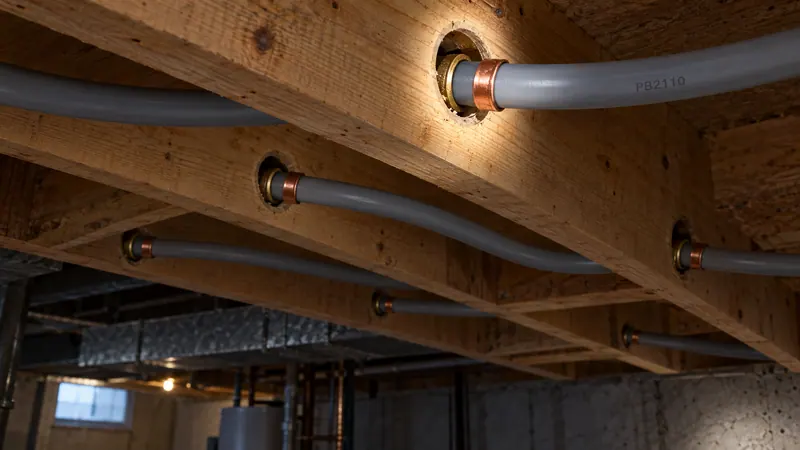
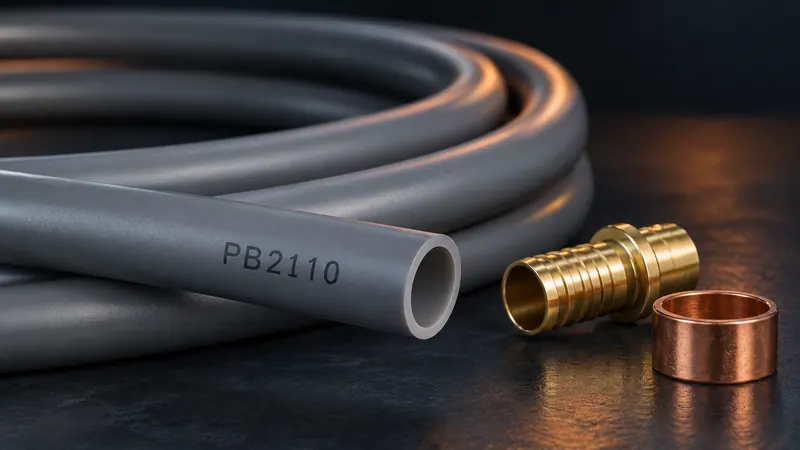
Bring a light and look for an accessible length of the smaller pipe carrying hot or cold water to a fixture. The utility room and an unfinished basement ceiling are useful starting points.19 Look for the printed material code, then photograph the nearest joint. Colour helps you know where to look; it cannot identify the pipe on its own. Missing or faded printing does not rule Poly-B out.17
Many houses have a mix. Copper may show at the water heater while Poly-B runs behind the walls and ceilings, and a newer PEX repair may connect to older Poly-B farther upstream.13 Look in more than one place, without twisting or bending the pipe.
Interactive identifier
What pipe is this?
Pick the colour, the printing, the fitting and where you found it. The identifier explains its verdict so you can check its reasoning against the pipe in front of you.
What the model shows, in words
How the identifier works
You make four choices: the pipe’s colour, any printing you can read, the kind of fitting at the nearest joint, and the room you are standing in. Each choice adds or removes evidence for poly-B, PEX, Kitec-style layered pipe, CPVC or copper. The result names the most likely material, how sure it is, and which of your answers carried the most weight. It runs entirely in your browser and stores nothing.
Colour is a clue, not an answer
Light to medium grey is the classic poly-B colour, sometimes with a slight blue cast. Poly-B was also made in black, blue, red, white and silver, so the tool never calls a pipe from colour alone. Red, blue and white are also the everyday colours of PEX, and orange with blue usually points to layered Kitec-style pipe. A rigid tube sold in straight lengths behaves nothing like flexible poly-B, which is why the tool also asks whether the pipe bends.
The print decides most cases
Printing along the pipe is the strongest evidence. “PB2110” or the standard number “CSA B137.8” identifies polybutylene. “PEX” with a code such as PEX 1006, or the standard CSA B137.5, identifies cross-linked polyethylene. “CPVC 4120” or CSA B137.6 identifies CPVC. If no print is visible, look at another accessible length and move your light or camera around it. Leave the pipe in place. Missing print means the material needs more checking; it does not clear the system of Poly-B.
Reading the fittings
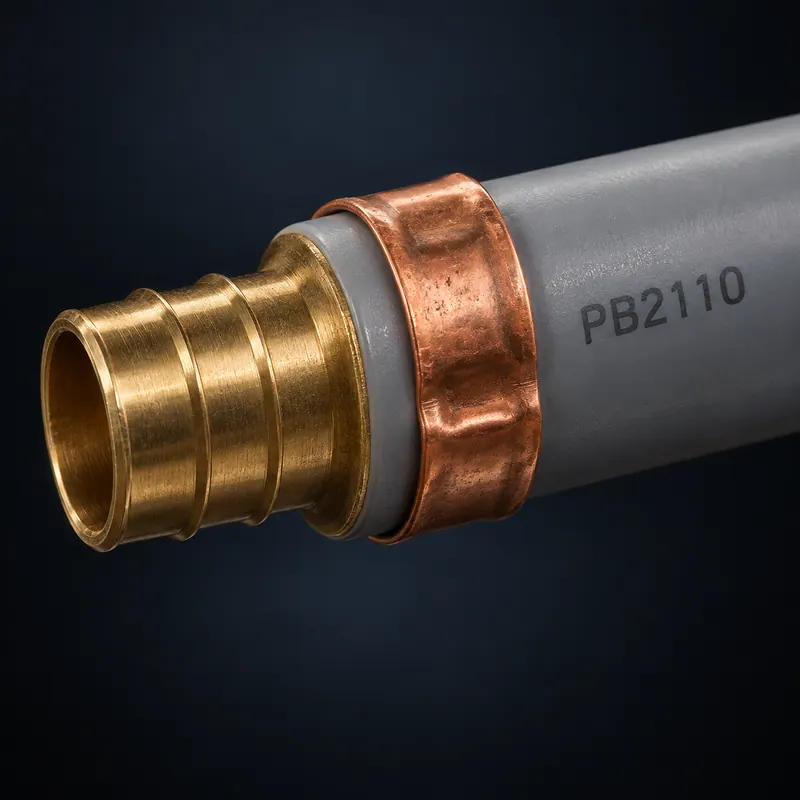
Poly-B joints may use copper or brass inserts with plain copper crimp rings, or grey plastic acetal inserts. PEX also has metal and polymer fittings and several joining systems. Ring appearance adds context, but fittings and ring colour alone are not reliable confirmation when the print has worn off. A copper fitting on grey plastic still leaves the tube material to identify. Check the tube, printing and joint together.
Why the room matters
Where you found the pipe changes what else it could be. At a water heater, the last connection is often copper or a braided flexible line even in a poly-B house. Under a sink or behind a toilet you may only see a short stub and a shut-off valve. A basement ceiling usually shows long runs with plenty of print. Outdoors or at the foundation you may be looking at the buried service line, which can be a different plastic entirely.
Trusting the verdict
A “likely poly-B” result means your answers match how poly-B was installed in Canada, not that someone has inspected your system. A mixed house can give different verdicts in different rooms, and that is useful information in itself. When the result matters for insurance or a sale, photograph the print and the fittings and have a plumber or home inspector confirm them in person.
Visual Identification Guide
The three things to check on any exposed supply pipe.
Colour & Material
Key Markings
Room 1
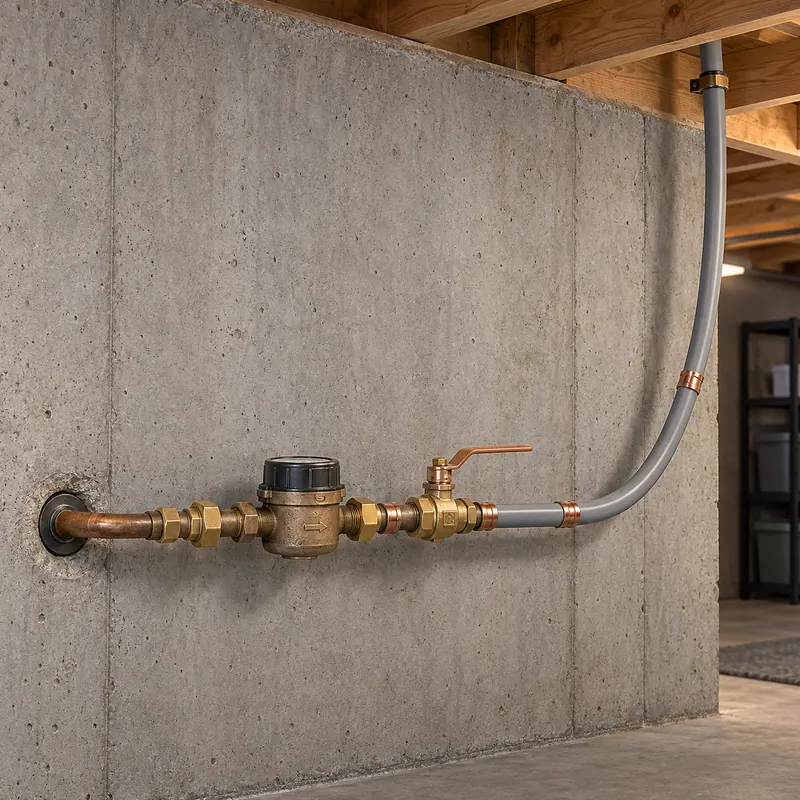
Main shut-off and water meter
Start where the water enters the house, usually on the basement or utility-room wall nearest the street. BC Housing’s leak-prevention bulletin tells every homeowner to find this valve anyway, because it is what you close first in a leak.15
Look at the pipe on both sides of the valve. The line coming in from outside is the service line; the pipe leaving the valve feeds the house. Poly-B on the house side usually means the distribution system is poly-B. If you see copper here, keep looking: some houses switch to poly-B a few feet later.13
While you are there, check whether a pressure-reducing valve is fitted; when there is one, it is usually at or just after the main shut-off.8 It matters later, because high pressure is one of the stresses that shortens poly-B’s life.
Room 2
Water heater
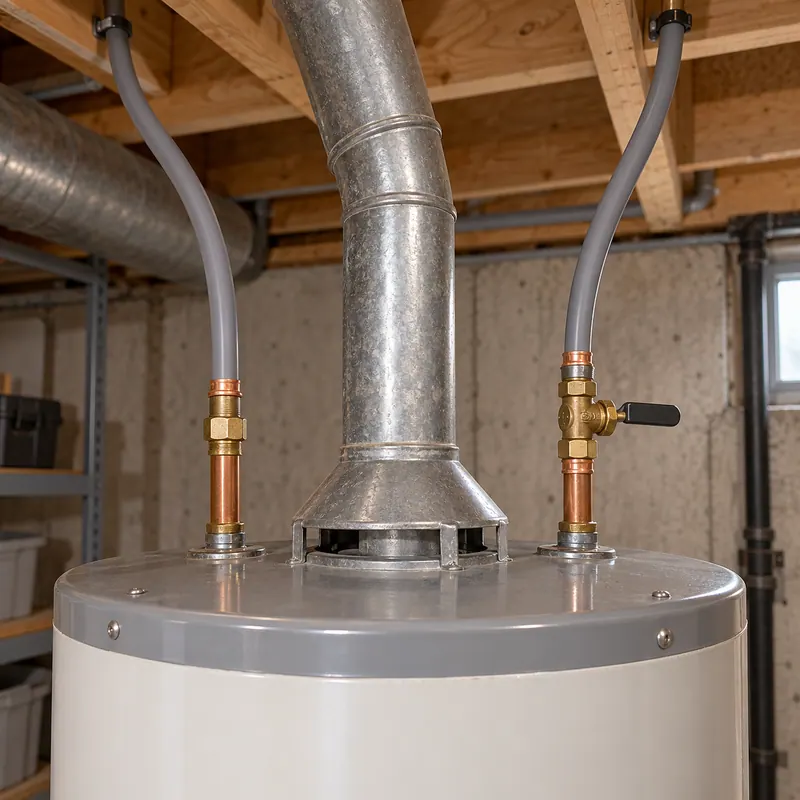
The water heater is the most reliable place to see pipe up close, since the hot and cold lines run out in the open. Follow both lines up from the top of the tank.
In a poly-B house you will often see a short copper or braided metal connector first, then the grey plastic. One British Columbia home inspector explains why: poly-B is sensitive to heat and should not sit within 18 in (about 45 cm) of a water heater, so installers joined it with metal connectors. The same inspector says poly-B should clear a single-wall gas vent connector by 6 in (about 15 cm).8 If grey pipe touches the tank fittings or runs close to the flue, mention it to a plumber.
The 1995 National Plumbing Code also barred poly-B from continuously circulating hot water lines, and some makers printed that warning on the pipe.112 A recirculation loop running in grey pipe is worth flagging.
Rooms 3 and 4
Under sinks and behind toilets
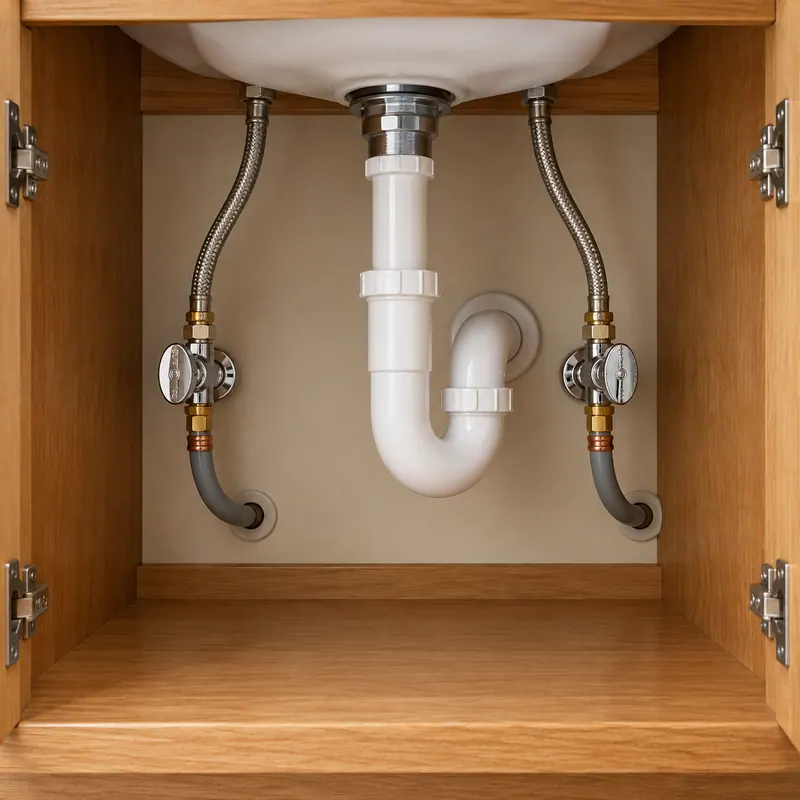
Open the kitchen and bathroom cabinets and look where the supply lines come out of the wall or floor. Behind each toilet there is a similar stub near the floor. These stubs are often the only pieces of poly-B visible upstairs.
Note the shut-off valves too. Jon Eakes reports readers repeatedly describing poly-B valves under sinks and toilets that simply blew apart, and he recommends replacing them because they are easy to reach.10 The braided hose from valve to faucet is not the pipe you are identifying; look at what comes out of the wall.
Don’t pull hard on a stub to see more of it. Brittle pipe does not like being bent, and a crack behind the wall is the outcome you are trying to avoid.
Rooms 5 and 6
Laundry, basement ceiling and crawl space
Laundry. The hot and cold valves for the washer sit in a small box or on the wall behind the machine. The pipe feeding them is frequently visible for a short distance from below in an unfinished basement.
Basement ceiling. An unfinished basement is the easiest place to identify a whole system, since the main runs cross the joists in the open. In a finished basement, lift a drop-ceiling tile or two near the utility room.9 Look for long grey runs, copper crimp fittings at elbows and tees, and plastic hangers. The 1995 code called for horizontal polybutylene to be supported at least every metre with hangers that did not compress, cut or abrade it, so sagging runs or bare-wire hangers are worth noting.11
Crawl space. In houses without a full basement, the supply runs are often in the crawl space. Take a light and look along the joists near the main shut-off. Also note any length of pipe that sits near a vent, a furnace or a window, since heat and sunlight both age polybutylene.1
Fittings
Read the joints: crimp rings and inserts
Fittings add context when the print has faded. Alberta installations primarily used copper or brass insert fittings held by soft copper crimp rings.2 Other systems may have grey plastic acetal inserts, which are a different plastic from the tube itself; some were paired with aluminum bands.62
The Plastics Pipe Institute compares PB and PEX crimp rings for the same nominal pipe size: PB rings are generally wider and thinner, and usually plain copper in colour, while PEX rings are commonly black-oxide coated and may be stamped “PEX”.5 Those differences explain why the parts are not interchangeable. They are difficult to judge from an installed joint or a photo, so use them alongside readable pipe markings rather than as a verdict.
PEX also uses cold-expansion rings, clamps and press connections.6 A home may contain more than one joining system after repairs. A newer joint identifies only the section you are looking at; follow the visible run to see where the material changes.
Outside
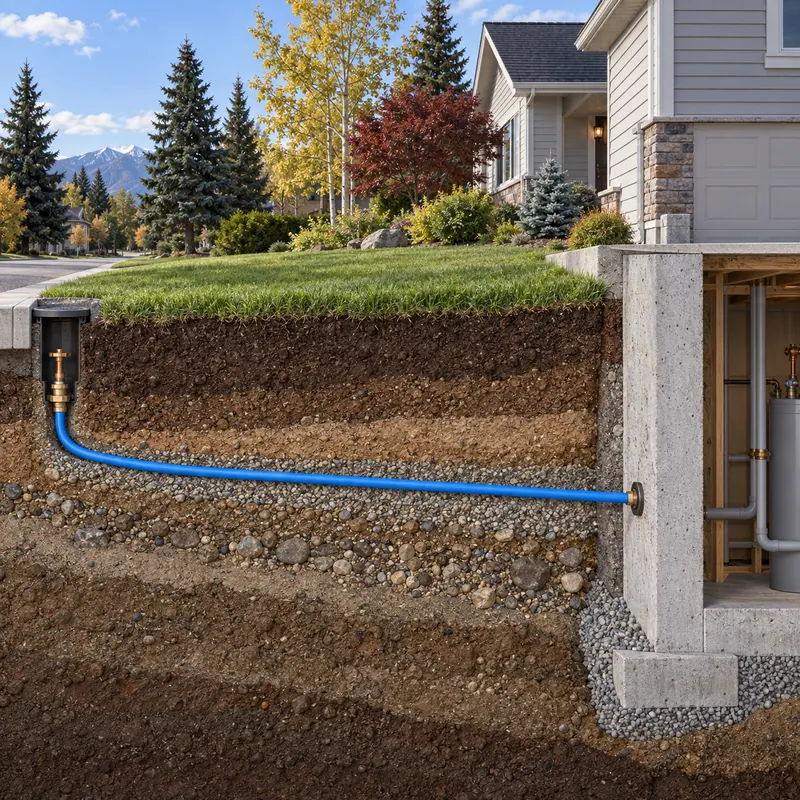
Outside and underground: the service line
The buried line from the curb stop to your foundation can also be polybutylene. The Canadian Shell settlement named “PB yard service lines” as their own category, separate from indoor plumbing and heating.4 One Kamloops homeowner told Jon Eakes that the poly-B line from the curb stop broke under the house and flooded the basement.10
You rarely see this pipe except where it rises through the basement floor to the main shut-off. Colour is especially unreliable here. Poly-B was made in blue as well as grey,1 but polyethylene tubing, covered by its own CSA standard for cold-water pressure services, is also used for water services.12 Read the print on the exposed length above the floor, and if there is none, ask your municipality or a plumber what material was used for services in your subdivision.
Behind the drywall
See through a finished bathroom wall
Move the flashlight across a finished bathroom to reveal the supply lines behind the tile and drywall. Illustrative layout; your walls will differ.
What the model shows, in words
What the model shows
The first image is an ordinary finished bathroom: vanity, toilet, tub surround and painted drywall. Drag the flashlight and a circle of the wall turns transparent, revealing the grey supply lines behind it. Release it on a hotspot to read what that part of the system is and why it matters. The layout is a typical one for a 1980s or 1990s house, drawn to explain, not measured from a real home.
Where poly-B runs in a bathroom
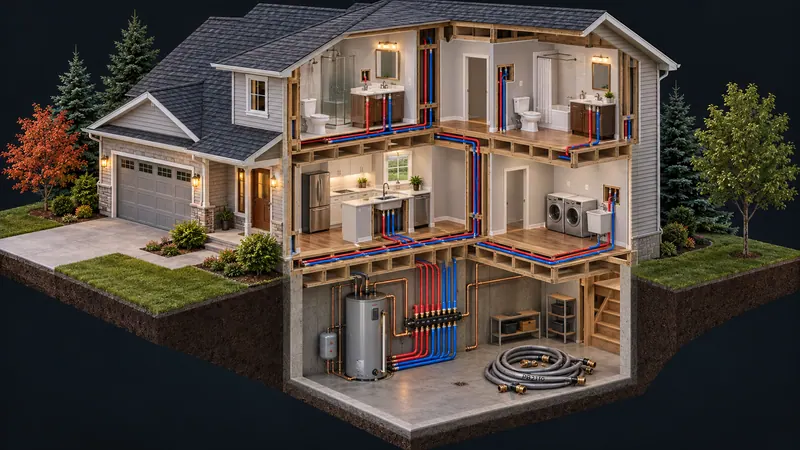
Supply lines usually rise from the basement through the floor plate or drop from the ceiling, then turn toward each fixture. Behind the vanity they end in two stubs; behind the toilet, one. The tub and shower valve is fed from behind the wall, often reachable through an access panel in the next room. Every turn is either a gentle bend in the pipe or a crimped elbow, and the elbows are where the model places its warnings.
Clues you can see from the room
You do not need to open anything to gather evidence. A grey stub coming out of the wall under the sink, a plastic shut-off valve, a copper crimp ring just visible behind a trim plate, or an access panel that shows grey pipe behind the tub all point the same way. The model highlights each of these spots so you know where to look in your own bathroom.
What the opened wall reveals
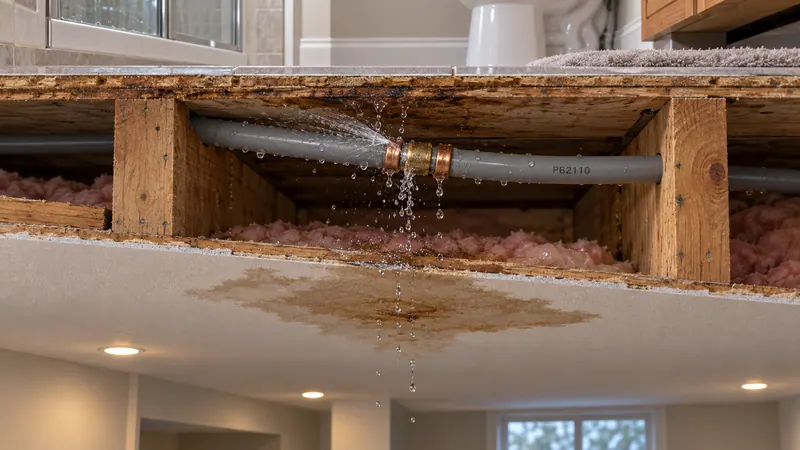
Switch to the second image and the same wall is shown opened, as it would be during a replacement. Long runs sit between studs, clipped at intervals, with crimp fittings at tees and elbows and short stubs through the drywall. This is the view a plumber plans from: the openings in a repipe usually go where fittings and turns are, which is why a replacement leaves a pattern of small patches rather than a missing wall.
Identifying without demolition
A readable material marking on an exposed length can confirm that section without opening a wall. It cannot establish the material of every hidden branch. A plumber can assess the extent using visible runs, access panels, fixture stubs and repair records, and explain where uncertainty remains. Ask what any proposed access opening would establish before it is made.
Reading the print on the pipe
Plastic pressure pipe is printed along its length. These are the strings that tell materials apart.
| If the print includes… | It is most likely | Notes |
|---|---|---|
| PB2110, PB, Polybutylene, CSA B137.8 | Poly-B | Often with a date code and a 100 psi at 180 °F rating62 |
| PEX, PEX 1006 or 1106, CSA B137.5, ASTM F876, SDR 9 | PEX | Footage marks at least every 5 ft are common6 |
| PEX-AL-PEX, PE-AL-PE, CSA B137.10 or B137.9 | Layered composite pipe (for example Kitec) | An aluminum layer sits between two plastic layers1210 |
| CPVC 4120, ASTM D2846, CSA B137.6 | CPVC | Rigid straight lengths joined with solvent cement6 |
| CSA B137.1 (polyethylene) | PE cold-water service pipe | Cold water only; usually the buried service line12 |
| Type L, Type M, ASTM B88 | Copper | A metal tube, so the print only confirms the wall type |
Print can be faint, painted over or on the side facing the wall. Rotate your light rather than the pipe.
What poly-B is not: common look-alikes
Most mistakes come from assuming every plastic supply pipe is poly-B. These are the usual confusions.
| Material | How it looks | How to tell it apart |
|---|---|---|
| PEX | Flexible; white, translucent, red or blue | Prints “PEX”; black-coated rings, expansion rings or clamps; bends with few elbows16 |
| Kitec-style PEX-AL-PEX | Flexible; usually orange for hot and blue for cold | Layered wall with aluminum inside; brass fittings; its own class action10 |
| CPVC | Rigid plastic in straight lengths | Glued (solvent-welded) sockets; prints CPVC 41206 |
| PVC drain and vent pipe | Rigid white or cream plastic, larger diameter | Carries drainage, not household supply; not part of the poly-B question3 |
| ABS drain, waste and vent pipe | Larger rigid black pipe, often with a curved trap below a sink | Carries drainage or vent air rather than pressurized hot and cold water; look for ABS/DWV markings18 |
| Copper | Metallic, may have a patina | The tube itself is metal; distinguish it from a copper fitting joined to grey plastic3 |
| PE service pipe | Flexible plastic entering at the foundation | Cold water only; printed with CSA B137.112 |
Quick visual reference
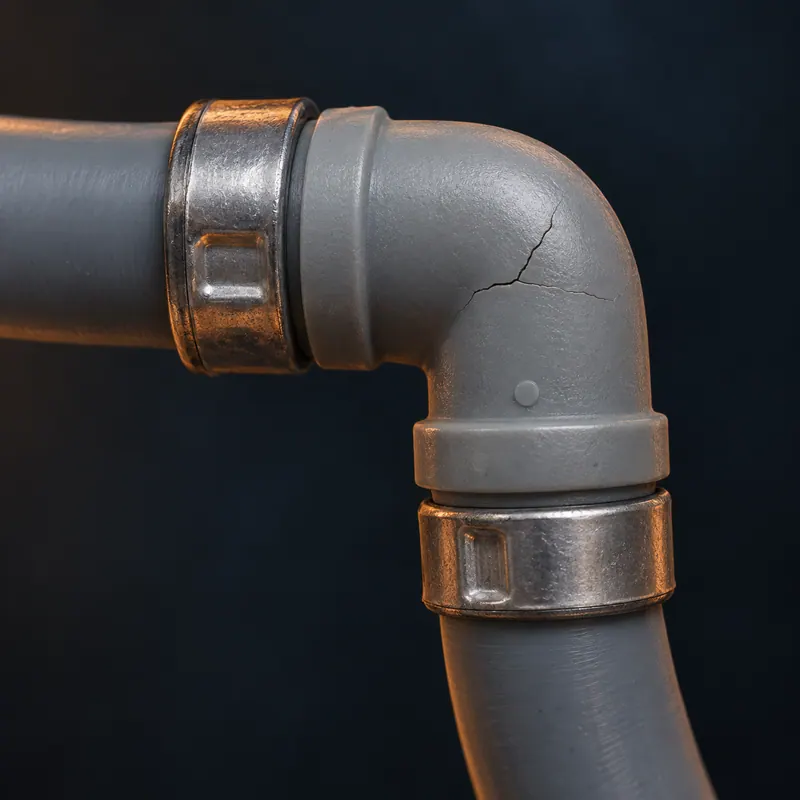
Photo-based self-check
Start with a wide photo showing where the pipe connects, then photograph the markings and the joint close up. These photos help a plumber understand your question and plan an assessment; they cannot show hidden piping or internal condition.
0 of 8 checked
What to tell a home inspector or plumber
A home inspector can look for poly-B wherever it is accessible, and a licensed plumber can confirm the material, its condition and how much of the house it serves.14 You will get a more useful visit if you say what you already know:
- The year the house was built and any renovation that touched the plumbing
- Where you saw grey pipe and what the print said, with your photos
- Whether the fittings you saw are copper or brass, plastic, or a mix
- Any leaks, repairs or insurance claims you know about, and when
- Whether your insurer or broker has asked about poly-B, and by what date they want an answer
If you are buying, ask the seller for everything about the plumbing, including leaks, repairs and past insurance claims, before your conditions expire.14 An inspection report that names the pipe material and its extent is also what an insurer is likely to ask for; one Alberta broker says a certified plumbing inspection is typically needed before a poly-B home can be insured.16
Need Professional Verification?
A plumber can confirm accessible materials, assess visible pipe and fittings, and explain what remains uncertain behind finishes. The directory explains how to vet one and which trade certification applies in your province. If you want a price at the same time, request a quote: the HAUSE desk replies with next steps and, where available and with your consent, a local contractor.
Questions · 6
Frequently asked questions
What colour is poly-B pipe?
I only see copper at my water heater. Can I still have poly-B?
How do I avoid confusing PEX with poly-B?
Are white plastic pipes poly-B?
Can a home inspector tell if I have poly-B?
An inspector can identify it wherever the pipe is exposed and note it in the report, but cannot see inside finished walls.14 A plumber can judge how much of the system it covers and whether any joints look worn.
Does a partial repipe mean the poly-B is gone?
Not necessarily. Repairs often replace only a failed section and join the rest with a transition fitting.8 Ask for invoices that say which lines were replaced, and look for grey pipe in the parts of the house the work did not reach.
Sources
- Alberta REALTORS® Association — What should I know about Poly-B piping in homes? (Bryan Statt, Jan. 16, 2025) · accessed 2026-09-28
- Alberta Municipal Affairs — Safety Tips: Polybutylene (Poly-B) Pressure Water Piping (Aug. 2016) · accessed 2026-09-28
- Westland Insurance — Has your broker asked if you have Polybutylene (Poly-B) plumbing? (Sept. 7, 2023) · accessed 2026-09-28
- Siskinds LLP — Defective plastic pipes (polybutylene) used in plumbing and radiant heating · accessed 2026-09-28
- Plastics Pipe Institute — TN-31, Appendix B: Comparison of PB and PEX Crimp Ring Fitting Dimensions (2023) · accessed 2026-09-28
- Plastics Pipe Institute — Plastic Pressure Pipe Materials in US/Canada, presentation to ICC 815 Committee (Oct. 30, 2023) · accessed 2026-09-28
- BFL Canada Risk Control Engineering — Ask an Engineer, Issue 17: Polybutylene Piping Systems (Mar. 2020), hosted by CHOA · accessed 2026-09-28
- Premium Home Inspections (Prince George, BC) — Poly-B Water Supply Piping · accessed 2026-09-28
- Lone Star Plumbing & Heating (Calgary) — Poly B Pipe Replacement · accessed 2026-09-28
- Jon Eakes — Plastic supply water pipe law suits: Poly-B, Kitec, PEX fittings (updated Nov. 26, 2025) · accessed 2026-09-28
- National Research Council Canada — National Plumbing Code of Canada 1995 (Articles 2.5.9 and 3.4.5) · accessed 2026-09-28
- CSA — Certification Notice, Plumbing Products No. 140: B137 Series-99 (Dec. 3, 2001) · accessed 2026-09-28
- SageWater — Polybutylene Piping Problems (FAQ: how can I tell if I have polybutylene piping?) · accessed 2026-09-28
- MyChoice — Poly-B plumbing insurance guide · accessed 2026-09-28
- BC Housing — Maintenance Matters No. 21: Preventing Water Leaks in Your Home · accessed 2026-09-28
- Armour Insurance — How to identify the type of plumbing your home uses · accessed 2026-09-28
- Square One — Poly-B plumbing: identifying codes and missing markings · accessed 2026-09-29
- IPEX — DRAIN-WAY ABS drain, waste and vent systems · accessed 2026-09-29
Keep going
Related guides

Updated 2026-09-29