PB2110 · The material
Polybutylene. Usually called Poly-B.
A flexible plastic pipe used for hot and cold water supply in many Canadian homes. Learn what the grey tube is, how its joints work, and why it deserves an assessment.
Poly-B in plain terms
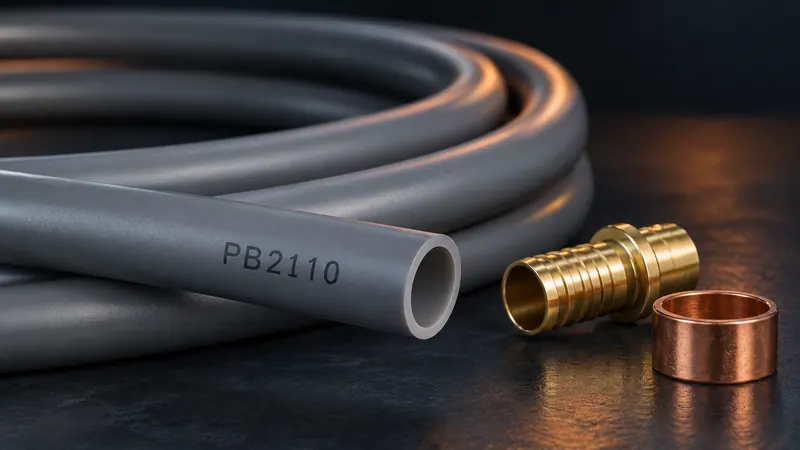
Polybutylene (PB) is a form of plastic resin that was used to manufacture water supply piping in North America from the late 1970s to the mid-1990s.1 In Canada the tubing was certified to a CSA standard, printed with codes such as PB2110 and CSA B137.8, and run through walls and ceilings to carry drinking water to taps, toilets, tubs and appliances.24
It was inexpensive, easy to install, and was considered a revolutionary alternative to traditional copper piping. One British Columbia home inspector puts its reach at more than 6 million homes in the United States and about 700,000 in Canada.17 Canadian risk engineers cite the same 700,000 figure as a common industry estimate.8
Poly-B is a supply pipe only. The drains, vents and sewer lines in the same house are made of other materials, and they are not part of the poly-B question.
Recognise the system before judging it
Three practical distinctions make the pipe easier to understand.
The supply tube
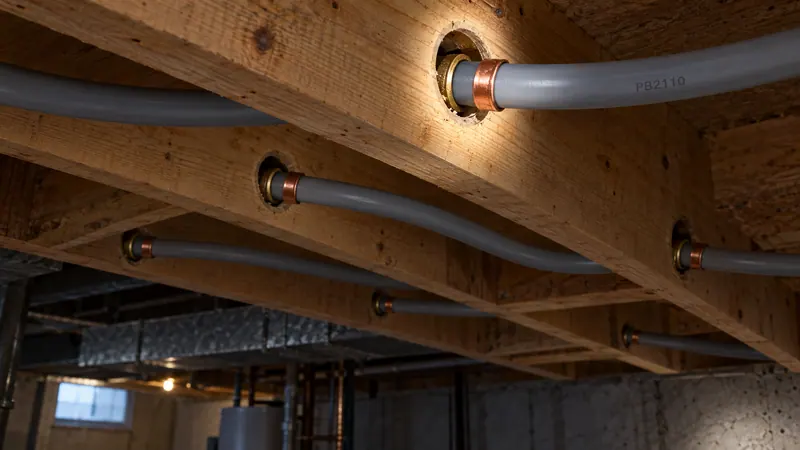
Poly-B carries pressurized hot and cold water to fixtures. Usually grey and flexible, it may be printed PB2110 or CSA B137.8. Colour alone is insufficient; read the identification field guide.24
The connections
Canadian systems include copper or brass inserts with copper crimp rings as well as plastic fittings. A metal elbow joined to grey plastic does not make the tube copper.2
The other pipes nearby
PEX is a different plastic used in modern supply systems. Larger drain and vent pipes serve a different purpose. A home can contain several materials, particularly after a repair or partial repipe.3
Why builders chose it
Cheap, light, flexible and quick
Polybutylene arrived when copper was expensive. A copper system needed every length measured, cut and soldered, and every corner needed an elbow. Plastic tubing was cheap to make, light to haul to site, flexible enough to bend around framing, and joined without a torch.1
Quebec builders saw the same advantages when they adopted it in 1983: it came in coils, needed fewer joints, cost less in both material and labour, and ran more quietly than copper.15 For a builder putting up a subdivision of similar houses, those savings added up quickly.
The material was rated for hot and cold water at up to 100 psi (690 kPa) and 82 °C (180 °F), which covered normal household service.2 What those ratings did not capture was how the pipe would behave after decades of hot, disinfected water, because no standard chlorine-resistance test existed for it at the time.3
History
History & Timeline
1970s: Introduction. Polybutylene entered North American plumbing as an alternative to copper for hot and cold water distribution.3 CSA published the first edition of its polybutylene pressure piping standard, B137.8, in 1977.9
Late 1970s through the 1990s: Canadian installations. Poly-B became common in homes from this era.1 Build year helps you know where to investigate, but a renovation can introduce it into an older home and a later repair can leave a mix of materials. The printed material code and visible plumbing are better evidence than the date alone.
1980s to mid-1990s: Problems emerge. Some systems suffered premature oxidative, brittle failures, including failures involving plastic fittings.3 Leaks led to class actions in the United States.13
1995–2005: Phase-out. Shell stopped supplying pipe-grade resin to Canada and the United States in 1995–96.4 Alberta records that Canadian pipe production stopped in 1998.2 Production dates do not establish when every remaining length was installed. The material left the National Plumbing Code of Canada with the 2005 edition; a historical Quebec account describes provincial code use until 2008.1512
Illustrative model
Inside the polymer chain
Turn up the heat and the disinfectant and watch where oxidation attacks a polybutylene chain, and why polyethylene and PEX hold up differently. Simplified for clarity; rates are illustrative.
What the model shows, in words
What the model shows
The model draws a short stretch of polybutene-1, the polymer in poly-B. Its backbone is a zig-zag of carbon atoms, and every second carbon carries an ethyl side group. The carbon holding that side group keeps only one hydrogen, known as a tertiary C–H. A matching stretch of polyethylene sits alongside for comparison; its backbone is almost entirely CH₂ units with no side groups. Atoms are drawn larger than life and bond angles are simplified, so read it as a diagram, not a structure file.
Why one hydrogen matters
Oxygen-based attack removes a tertiary hydrogen far more readily than a hydrogen on a CH₂ group. Polyethylene has only a few scattered tertiary sites, while polybutylene has one on alternating carbons along the whole chain. In the model, weak points glow as you raise the oxidant level, and the polybutylene strand lights up across its length while the polyethylene strand barely changes. This is the core reason poly-B is more oxidatively unstable than PE or PEX.
Antioxidants run out
Pipe makers blended antioxidant stabilisers into polybutylene to make up for its weakness. They work by being consumed, and warm water flowing past the inside wall slowly draws them out. The model shows them as a shield along the inner surface. Advance the years-in-service slider and the shield thins, faster with hotter water. Once it is gone, oxidation of the chain speeds up sharply, which is why failures can seem to arrive suddenly after years of good service.
Chain scission and brittleness
When an oxidant pulls a tertiary hydrogen away, the chain can break at that point. Shorter chains tangle less with their neighbours, so the plastic loses the toughness that let it flex. In the model, broken segments fade and the inner skin of the pipe wall turns from springy to glassy. Tiny cracks start on that inside surface, out of sight, and grow outward under water pressure until one reaches the outer wall as a pinhole or split.
Heat, pressure and disinfectant together
The sliders for water temperature, disinfectant level and pressure change how fast the shield wears and how many chains break. Their effects multiply rather than add. Laboratory work on polybutylene pipe held at 80 °C found that chlorinated water cut oxidation resistance and mechanical strength over time, and that pressurised samples lost more antioxidant than unpressurised ones. The model follows those directions but its speeds are invented for teaching, so it cannot predict the life of your pipe.
The crystal twist
A final toggle shows a quirk of polybutene-1. Cooled from the melt, it first forms a less stable crystal arrangement that converts to a stable one at room temperature over days or weeks, shrinking and densifying as it goes. Pipe coiled during that period can set in its coiled shape. The model animates this as a coil relaxing unevenly, a reminder that some stress was built in before a plumber ever unrolled the tube.
Chemistry
Molecular Chemistry: Why Poly-B Fails
Tertiary C–H bond vulnerability. Every polyolefin has CH₂ groups in its backbone, but polybutylene also has a tertiary carbon–hydrogen bond on alternating backbone carbons, opposite each ethyl branch. Oxygen reacts with those tertiary bonds much faster than with CH₂, so the chain breaks there. Polyethylene has only a few random tertiary sites, which is why PE and PEX pipe are more oxidatively stable.5
Chain scission. When disinfectant in the water reacts at these weak points, the polymer chains break. That breaking, called chain scission, leaves the plastic brittle and ready to crack under load.5
Stabilisers that wash out. Manufacturers compensated by adding high levels of antioxidant stabilisers, but warm water extracts them from the inside surface over time. Once they are depleted there, the inner wall embrittles and cracks form.5 Because the damage begins on the inside, a degraded pipe can look perfectly normal from the outside.8
Pressure adds to it. A 2019 study in Polymer Degradation and Stability aged polybutylene pipe in hot water at 80 °C. In chlorinated water, oxidation resistance and mechanical properties fell as ageing went on, and samples held under pressure kept less antioxidant than those that were not. The authors concluded that both dissolved chlorine and water pressure promote degradation.7
Crystal structure. Polybutene-1 can crystallise in several forms. Pipe cooled from the melt first forms a metastable crystal type that changes spontaneously into a stable one at room temperature, a change that can take days or weeks and is accompanied by densification and shrinkage.6 A forensic polymer firm argues that pipe coiled during that change takes a set, so uncoiling it for installation stresses it, and that mixed crystal states make the material less uniform.5
Chemical Degradation Factors
Multiple factors accelerate the oxidative degradation of polybutylene. Tick the ones that apply to your house; the more you tick, the more reason to plan ahead.
0 of 6 checked
Fittings
Acetal Fitting Failures
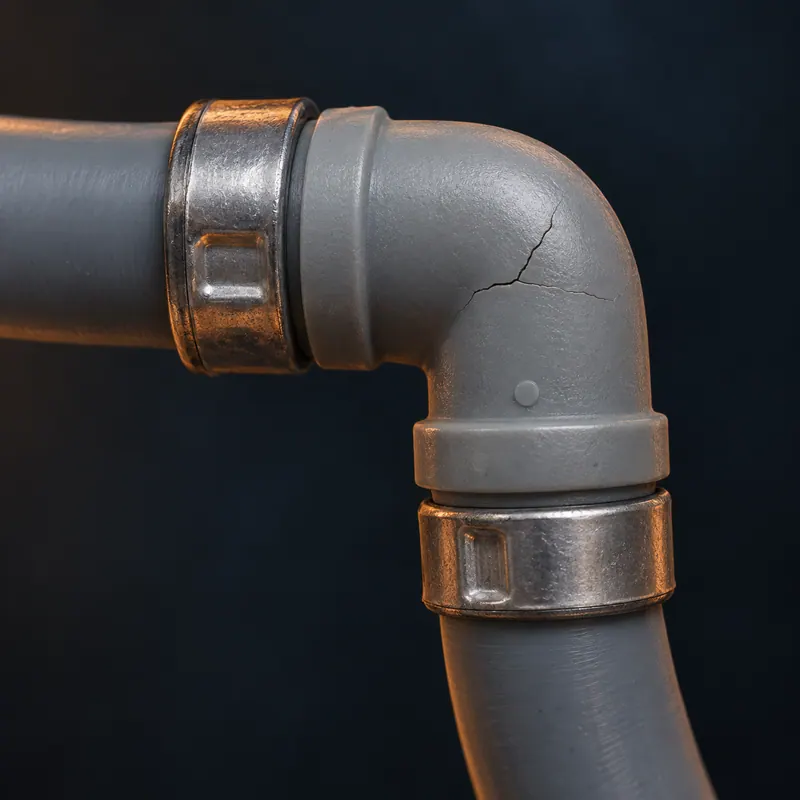
The grey molded fittings in early poly-B systems were not made of polybutylene at all. They were polyacetal, also called polyoxymethylene or POM, and they had poor resistance to hot chlorinated water. They could degrade quickly, lose ductility and crack, and the Plastics Pipe Institute attributes many of the early failures to them.43
In response, PB tubing makers switched to metal crimp fittings of copper or brass and promoted home-run systems with manifolds, which removed fittings from inside walls.4 Canadian practice followed the metal route: Alberta’s installations mostly used copper or brass insert fittings with soft copper crimp rings rather than plastic inserts with aluminum bands, and Quebec plumbers generally used copper fittings from 1986.215 That change significantly reduced, but did not eliminate, failures.
Other fitting issues include:
Progressive Deterioration
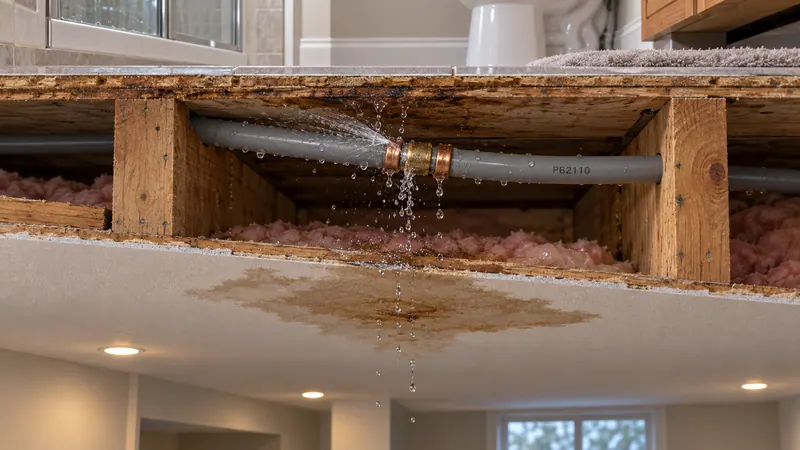
One deterioration mechanism begins on the inside surface: antioxidant stabilisers are depleted, the material becomes brittle, and fine cracks can grow through the wall under load.85 A leak may appear as a pinhole, a split or a failed connection.
This explains why a clean exterior cannot establish the pipe’s condition. It is not a sequence that every installation visibly follows, and it cannot tell you the remaining life of a specific system. A plumber’s assessment should describe both the visible findings and the limits of the inspection.
Types of Polybutylene Systems
Poly-B was used in more than one part of a house. The Canadian class-action settlements named several of them separately.14
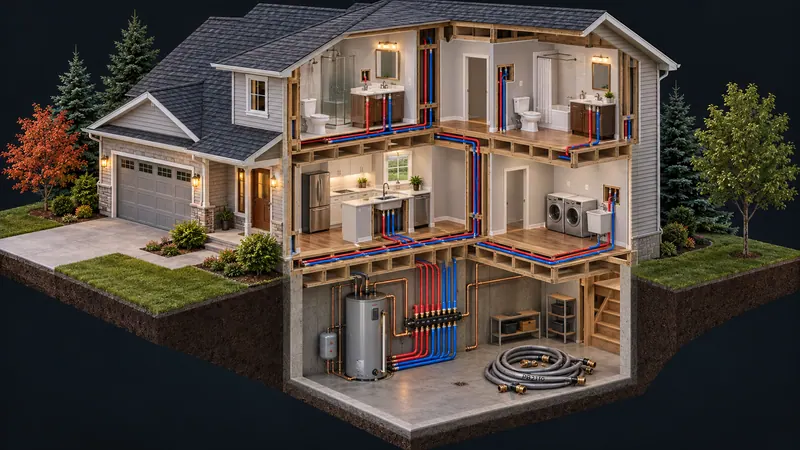
Main supply lines
Grey or blue-grey tubing running from the main shut-off to fixtures. These carry full supply pressure all the time, and they are what most people mean by poly-B plumbing.
Radiant and hot water heating
Some homes used poly-B in heating loops, including floors. Poly-B lets oxygen pass through its wall, which rusted metal parts of heating systems; pipe made from 1993 was modified to block oxygen.15 It can be costly to reach if embedded.
Yard service lines
The buried line from the curb stop to the house could also be polybutylene. A break there can flood a basement from outside the foundation.
Manifold (home-run) systems
Later systems fed each fixture from a central manifold with one continuous run, cutting the number of hidden joints.4
Key Facts & Statistics
Standards
The Canadian standard: CSA B137.8
Canadian poly-B was made and certified to CSA B137.8, Polybutylene (PB) Piping for Pressure Applications. CSA’s records show editions in 1977, 1986 and 1992, then a fourth edition inside the B137 Series-99 compendium.9 That 1999 compendium also withdrew B137.7, a separate standard for polybutylene pipe in cold-water systems, and cancelled certification to it.9 B137.8 stayed in the series until CSA withdrew it in July 2018.10
The 1995 National Plumbing Code of Canada set out how the pipe could be used. Article 2.5.9 required poly-B and its fittings to conform to B137.8, kept joints out of concrete slabs, and barred poly-B from continuously circulating hot water lines and the first metre of any branch off them.11 The same code required horizontal runs of CPVC or polybutylene pipe to be supported at intervals of no more than 1 m, and said hangers must not compress, cut or abrade polybutylene.11 The 2005 edition no longer contains a polybutylene article.12
In the United States, the product standard ASTM D3309 was withdrawn in 2010, along with the ASTM standards for plastic and metal PB crimp fittings.3 Polybutylene pipe is still made elsewhere in the world to ISO 15876, which is why the material itself did not disappear.3
Markings and brands
What the printing on the pipe tells you
Canadian poly-B carries a printed line along its length. Alberta lists what it contains: pipe size, the maker’s name or trademark, a date code, the material designation, a pressure rating, the certification agency and the standard, such as CSA-B 137.8.2 Some makers added a warning that the pipe was not for continuously circulating lines.2
The material code was PB2110, and the Plastics Pipe Institute names Qest and Vanguard as the American brands.4 Brand names on Canadian pipe vary, so the PB code and the CSA standard number are the more reliable clues. The identify guide shows where to find the print and how it differs from PEX.
Litigation
The lawsuits, and why Canada’s story is different
United States. Leaks led to class actions in Texas, Alabama and Tennessee. In 1995, in Cox v. Shell Oil Co. before the Chancery Court of Obion County, Tennessee, the court approved a national settlement under which Shell and Hoechst Celanese were to contribute US$950 million to replace eligible leaking systems and pay for leak damage. An Alabama settlement, Spencer v. Shell, added contributions from DuPont.13
Canada. An Ontario action named Shell, DuPont and Hoechst Celanese. Shell settled for C$20 million, with final Ontario approval on April 16, 2004 and claims due by June 18, 2005. DuPont, which made the raw material for acetal fittings, agreed to pay successful claimants with acetal-fitted systems 25 % of the cost of a re-plumb and earlier repairs. A settlement with Celanese followed in 2010.14 A Quebec class action begun in 1998 settled in 2004.15 No compensation program is open today.
Why the risk is discussed differently here. Several Canadian sources describe a milder record than the American one. Most Canadian systems used metal fittings instead of acetal ones.2 Home-improvement writer Jon Eakes adds that many U.S. failures were in extremely hot mobile-home roof spaces in the southern states and that Canadian chlorine levels are well below those in parts of the U.S.16 A Quebec columnist put typical Canadian drinking water at under 2 ppm of chlorine.15 The same writers now report more Canadian failures as the pipe ages, especially in Calgary, and insurers have tightened their stance, so a milder history is not the same as a clean bill of health.161
Comparison
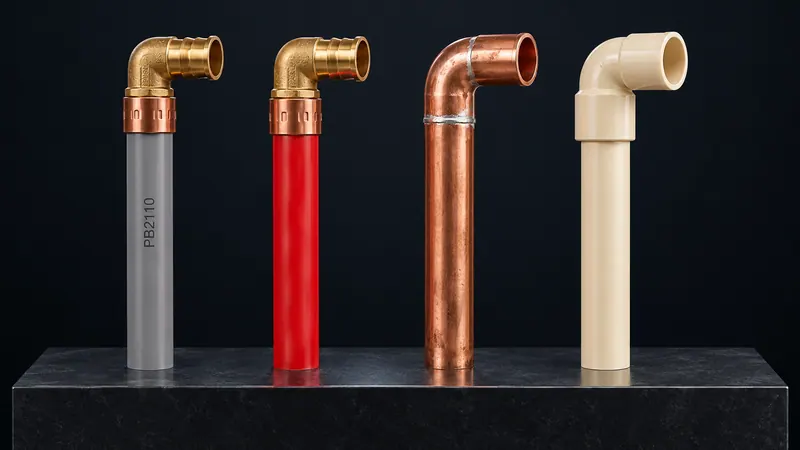
PEX vs Poly-B: Technical Comparison
Cross-linked polyethylene (PEX) and polybutylene are different materials, even though both are flexible plastic tubing. The Plastics Pipe Institute’s Technical Note TN-31 sets out the differences:3
- Cross-linking: PEX molecules are permanently linked during manufacture, which improves long-term pressure resistance at high temperature, resistance to slow crack growth from scratches, and resistance to creep at fittings. Poly-B is not cross-linked.
- Wall thickness: PEX tubing is made at SDR 9 and PB tubing was SDR 11, so PEX walls are up to 22 % thicker for the same pressure rating of 100 psi at 82 °C.
- Chlorine testing: Every PEX tube for drinking water must pass ASTM F2023 testing for a minimum extrapolated life of 50 years. No such test applied to PB tubing in the 1980s and 1990s.
- Fitting compatibility: Because wall thicknesses differ, PEX and poly-B insert fittings and crimp rings are not interchangeable. A 1/2 in PB ring is wider and usually plain copper; a PEX ring is thicker and usually black-oxide coated, sometimes stamped “PEX”.
- No acetal: PEX fittings are lead-free brass, bronze, copper, stainless steel or chlorine-resistant polymers such as PSU and PPSU.
Poly-B, PEX, copper and CPVC side by side
Sources: Plastics Pipe Institute TN-31 and its 2023 code-committee presentation, CSA, the National Plumbing Code, ASTM and the Alberta REALTORS® Association, with the freeze point from an Alberta broker.34101220121 Installed prices are on the replacement page, with their sources.
Key finding
PEX and poly-B are fundamentally different materials. PEX is cross-linked, thicker-walled and tested for chlorine resistance; poly-B is none of those, and its standards have been withdrawn in both Canada and the United States.310 Their fittings and crimp rings cannot be swapped, so any repair that joins the two needs a proper transition fitting.
Confirm what you have. Plan the next step.
Not every Poly-B system has leaked. Internal deterioration can be hidden, and BFL Canada’s risk engineers describe pressure and temperature measures as ways to slow deterioration while a repipe removes the material.8
Start with the identification guide, then ask a plumber to assess the extent of the system, the connections and its repair history. Check any insurance conditions with your own insurer.18 A replacement quote should define which lines, access openings and finishing work are included.
Questions · 6
Frequently asked questions
What does PB2110 mean on a pipe?
Is poly-B the same thing as Kitec or PEX?
When did Canada stop allowing poly-B?
Why did poly-B fail more in the United States than in Canada?
Is poly-B safe to drink from?
The concerns about poly-B are leaks and water damage, not the drinking water. The pipe was CSA-certified for potable water, and Alberta notes that previously accepted plumbing remains acceptable unless it poses a health or safety hazard.2
Sources
- Alberta REALTORS® Association — What should I know about Poly-B piping in homes? (Bryan Statt, Jan. 16, 2025) · accessed 2026-09-28
- Alberta Municipal Affairs — Safety Tips: Polybutylene (Poly-B) Pressure Water Piping (Aug. 2016) · accessed 2026-09-28
- Plastics Pipe Institute — TN-31: Differences Between PEX and PB Piping Systems for Potable Water (2023) · accessed 2026-09-28
- Plastics Pipe Institute — Plastic Pressure Pipe Materials in US/Canada, presentation to ICC 815 Committee (Oct. 30, 2023) · accessed 2026-09-28
- Plastic Expert Group — Polybutylene (PB) Pipes: Unveiling Three Critical Features Affecting Reliability · accessed 2026-09-28
- Xin R. et al. — Polymorphic Behavior and Phase Transition of Poly(1-Butene) and Its Copolymers, Polymers 10(5):556 (2018) · accessed 2026-09-28
- Fujii T. et al. — Influence of residual chlorine and pressure on degradation of polybutylene pipe, Polymer Degradation and Stability 167:1–9 (2019) · accessed 2026-09-28
- BFL Canada Risk Control Engineering — Ask an Engineer, Issue 17: Polybutylene Piping Systems (Mar. 2020), hosted by CHOA · accessed 2026-09-28
- CSA — Certification Notice, Plumbing Products No. 140: B137 Series-99 (Dec. 3, 2001) · accessed 2026-09-28
- CSA Group — B137 Series-17, Thermoplastic pressure piping compendium (B137.8 withdrawn July 2018) · accessed 2026-09-28
- National Research Council Canada — National Plumbing Code of Canada 1995 (Articles 2.5.9 and 3.4.5) · accessed 2026-09-28
- National Research Council Canada — National Plumbing Code of Canada 2005 · accessed 2026-09-28
- U.S. Court of Appeals, Fifth Circuit — Richard v. Hoechst Celanese Chemical Group, No. 02-41377 (Dec. 19, 2003) · accessed 2026-09-28
- Siskinds LLP — Defective plastic pipes (polybutylene) used in plumbing and radiant heating · accessed 2026-09-28
- Guide Perrier — Yves Perrier, plomberie de polybutylène au Québec (Nov. 11, 2015) · accessed 2026-09-28
- Jon Eakes — Plastic supply water pipe law suits: Poly-B, Kitec, PEX fittings (updated Nov. 26, 2025) · accessed 2026-09-28
- Premium Home Inspections (Prince George, BC) — Poly-B Water Supply Piping · accessed 2026-09-28
- Westland Insurance — Has your broker asked if you have Polybutylene (Poly-B) plumbing? (Sept. 7, 2023) · accessed 2026-09-28
- Lone Star Plumbing & Heating (Calgary) — Poly B Pipe Replacement · accessed 2026-09-28
- ASTM International — B88-20 Standard Specification for Seamless Copper Water Tube · accessed 2026-09-28
- Armour Insurance — How to identify the type of plumbing your home uses · accessed 2026-09-28
Keep going
Related guides
Updated 2026-09-29