FAQ · 84 questions
Frequently Asked Questions
Straight answers about polybutylene plumbing in Canadian homes, each one checked against the sources listed at the foot of the page.
How to use these answers
The questions below are grouped the way people usually meet the problem: first working out whether the pipe is poly-B, then weighing the risk, dealing with an insurer, pricing a replacement, and handling a sale or a condo board. A final group covers provincial differences and the history of the standard and the lawsuits.
Each answer ends with numbered citations. Where a figure comes from a contractor or a company press release, the answer names who said it, because those numbers describe one firm’s experience rather than a market average. Where an often-repeated claim could not be traced to any source, the answer says so plainly instead of repeating it.
Nothing here is legal, insurance or engineering advice for a specific house. For that, talk to a licensed plumber, your broker or a lawyer — or request a quote and the HAUSE desk will reply with next steps.
Jump to a topic
- Finding and naming the pipe12 questions · Identification
- Understanding the concerns16 questions · Risks
- Insurers, renewals and claims11 questions · Insurance
- Replacing it14 questions · Replacement & cost
- Real estate8 questions · Buying & selling
- Condominiums and strata buildings6 questions · Condos & strata
- Province by province9 questions · Regional
- Codes, standards and lawsuits8 questions · Codes & history
Identification · 12
Finding and naming the pipe
How to recognise poly-B, where to look, and what the markings and fittings tell you.
What is poly-B plumbing?
Poly-B is short for polybutylene, a flexible plastic that Canadian builders used for water supply piping from the late 1970s to the late 1990s. It carried hot and cold drinking water to taps, toilets, tubs and appliances; drains and vents are separate systems made of other plastics. Builders liked it because it cost less and went in faster than soldered copper. The What is poly-B? guide covers the material in depth. 12
What does poly-B pipe look like?
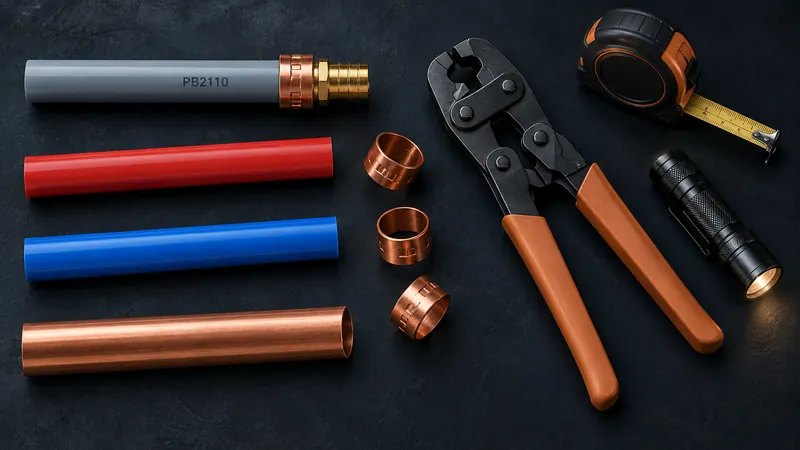
Look for a flexible plastic water-supply tube, commonly light grey or grey-blue, with markings such as PB2110 or CSA B137.8. Joints may use copper or brass inserts with copper crimp rings, or plastic fittings. Grey colour and a copper-coloured ring are clues to investigate; the printed material designation is stronger evidence. Other colours existed, and a missing readable stamp does not rule Poly-B out. The visual identification guide shows the details room by room. 34
What markings are printed on poly-B pipe?
Look for the material code PB2110 and the Canadian standard number CSA B137.8. Alberta’s fact sheet adds that the print line also shows pipe size, the maker’s name or trademark, a date code, the pressure rating and the certification agency, and some makers stamped a warning against continuous circulating hot-water use. Square One cautions that a missing stamp does not clear the pipe, because print fades or sits on the hidden side, so colour, fittings and the age of the house still count. 546
Where in the house should I look for poly-B?
Start wherever supply lines are exposed: at the water meter and main shut-off, on top of the water heater, in the utility or furnace room, under kitchen and bathroom sinks, behind the washing machine and across an unfinished basement ceiling. Drop-ceiling tiles can often be lifted for a look. Pipe seen in one spot doesn’t prove what runs inside finished walls, so check fixtures on every floor before drawing a conclusion. 278
How can I tell poly-B from PEX?
Read the tube rather than judging by colour or one fitting. PB2110 or CSA B137.8 identifies Poly-B; PEX, CSA B137.5 or ASTM F876 identifies cross-linked polyethylene. Both can be flexible, and both can use metal insert fittings. PEX has several joining systems, and a newer PEX repair can connect to older Poly-B farther along the run. If the markings cannot be read, photograph the tube and joints and ask a plumber to confirm the material. 349
Which homes are most likely to have poly-B?
Houses built or re-plumbed in Canada from roughly 1978 to 1997 form the main group, and Alberta Realtors puts the busiest years at 1985 to 1997. Alberta’s government says a house built before 1975 with no later plumbing work will not contain it. Because warehouse stock was still installed after production stopped, a home finished in 1998 or 1999 can have it too, and Quebec’s amended plumbing code allowed poly-B until 2008. 15102
Is every grey plastic pipe poly-B?
No. Colour alone is weak evidence: poly-B also came in other colours, and white or cream PVC is common on drain and vent lines. Poly-B is always a pressurised supply pipe, never a drain, so the wide pipes leading to the floor drain or stack are something else. The printed code settles most cases, and if you can’t find one, a plumber or home inspector can confirm the material quickly. 21
Why does the type of fitting matter?
Many early North American failures began at grey plastic insert fittings moulded from polyacetal, a material with poor resistance to hot, chlorinated water. Manufacturers later moved to copper or brass fittings, and Alberta reports that most installations there used metal inserts with soft copper crimp rings. A metal-fitted system avoids that particular weak point, although the pipe wall can still degrade. Fitting type also matters to underwriters and is one of the fields in the incident database. 657
Can the water service line from the street be poly-B?
It can. The Canadian Shell settlement defined its class to include owners of buildings with a polybutylene yard service line, alongside indoor plumbing and hot-water heating systems, so buried service pipe was made from the material as well. Check the print where the line rises through the basement floor at the meter. Ask your municipality which part of the service belongs to the property owner before planning any work on it. 11
Was poly-B used for in-floor or baseboard heating?
Yes, and it caused a separate problem there. In closed hot-water heating loops, oxygen passed through the pipe wall and corroded pumps, heat exchangers and other metal parts, sometimes within three or four years, according to Guide Perrier, which also reports that pipe made from 1993 was modified to block oxygen. Premium Home Inspections still advises never pairing poly-B with a boiler system. 101211
Will a home inspection find poly-B?
A general home inspector will usually identify poly-B wherever it is visible, such as at the water heater, under sinks or in an open basement ceiling. What an inspector cannot do is judge the inside wall of the pipe, where degradation begins, or see runs sealed behind drywall. Square One and MyChoice both point owners to a licensed plumber when they need a condition opinion or a replacement estimate. 47
My home was partly re-piped. How do I know how much poly-B is left?
Gather the paperwork first: invoices, permits and, ideally, a sketch showing which runs were replaced. MyChoice warns that a partial renovation can leave poly-B hidden behind new finishes, and Square One notes that insurers may ask what share of the house is each pipe type. Without records, a plumber can trace lines from the main or manifold and flag any grey sections still in service. 74
Risks · 16
Understanding the concerns
Hidden deterioration, connections, signs of water and the measures to discuss with a plumber.
Why does poly-B fail?
Three causes come up again and again. Disinfectants such as chlorine slowly oxidise the plastic from the inside; heat and pressure speed that up; and weak joints, whether over-tightened crimp rings or brittle acetal fittings, crack under load. Because the damage starts on the inner wall, a pipe can look normal until it splits or opens a pinhole. The risks guide walks through each mechanism. 41314
What happens to the plastic at the molecular level?
Polybutylene carries a tertiary carbon–hydrogen bond on alternating carbons of its backbone, and oxygen attacks those sites far faster than the CH₂ groups that make up most of polyethylene. Makers added antioxidants to compensate, but warm water gradually extracts them from the inner surface. Once that protection is gone, chains break, the plastic turns brittle and cracks grow outward. Plastic Expert Group also blames the resin’s shifting crystal forms for stressed, uneven material. 14
Does water pressure matter, or only chlorine?
Both matter. A 2019 study in Polymer Degradation and Stability aged polybutylene pipe at 80 °C in chlorinated and plain water, with and without internal pressure. Pressurised samples kept less antioxidant and showed stronger signs of oxidation, and the authors concluded that water pressure, not dissolved chlorine alone, promotes degradation. That finding supports the common advice to cap household pressure on poly-B systems. 1512
Are there warning signs before a poly-B pipe fails?
Often there are none. Alberta Realtors notes that poly-B usually keeps its colour and appearance as it deteriorates. Things worth noticing are old repairs, stains on ceilings below bathrooms, damp spots around fittings, kinks or tight bends near the water heater, and any cracking or flaking on the pipe surface. Each warrants a plumber’s visit, but a tidy-looking system is not proof of a healthy one. 1716
How long does poly-B last?
There is no reliable universal lifespan for an installed Poly-B system. Water chemistry, temperature, pressure, fittings, installation and repairs affect the concern. Age gives context, but cannot establish a failure date or how much life remains. Internal deterioration may be present while the exterior looks normal. Ask for an assessment that records the accessible findings and identifies which piping could not be inspected. 134
Are hot-water lines more at risk than cold?
Generally, yes. Heat accelerates the oxidation that embrittles the plastic, and hot lines near the water heater see the highest temperatures in the house. Premium Home Inspections advises keeping poly-B at least 46 cm (18 in) from a water heater and connecting the tank through copper or braided metal lines. Reports sent to the incident database record whether the failed line was hot, cold or both, so Canadian cases can test this pattern. 1412
Can poly-B freeze and burst?
Yes. Square One lists freezing among the risks, so the usual winter precautions apply: keep an empty house heated, protect lines on exterior walls and in crawlspaces, and shut off and drain outdoor faucets from the inside valve. Wawanesa recommends turning the water off entirely if you are going away in winter. 41718
Does sunlight damage poly-B?
It can. Westland Insurance and the Insurance Bureau of Canada both list ultraviolet exposure among the factors that weaken poly-B, and Calgary’s Lone Star Plumbing notes that pipe left unprotected outdoors before installation may have a shorter life. Inside a finished house the pipe is shaded, so this mainly matters for runs near skylights and windows or in exposed outdoor locations. 2198
Why did Canada see fewer failures than the United States?
Renovation commentator Jon Eakes points to three differences: few acetal in-line fittings were used here, many U.S. failures happened in scorching mobile-home roof spaces in southern states, and Canadian chlorine levels are lower. After a stream of reader letters he conceded the pipe may be aging poorly in Calgary too, and that the gap may be mostly one of timing. A Halifax inspector reports that local systems with copper fittings rarely fail. 2021
Will my poly-B definitely fail?
A material identification cannot predict whether or when your particular system will leak. Poly-B has documented concerns involving internal deterioration and connections, so a clean-looking pipe deserves more than a colour check. Review its extent, visible condition and repair history with a plumber, and check any insurance conditions with your insurer. A repair of one section leaves the remaining Poly-B in place. 134
What can I do to lower the risk while I plan a replacement?
Know where the main shut-off is, investigate any signs of water, and ask a plumber to assess pressure, connections and installation defects. Leak sensors and an automatic shut-off can help limit water damage; their acceptance as an interim measure is a question for your insurer. Pressure or temperature adjustments should follow professional advice for the actual system. These measures do not remove the remaining Poly-B or establish a new lifespan. 134
Should I turn my water heater down to protect poly-B?
Only with care. Heat speeds poly-B’s breakdown, but a tank kept too cool can grow Legionella bacteria, which multiply fastest between 20 °C and 50 °C. NB Power says Canadian tank heaters come factory-set to 60 °C, Square One cites BC Hydro’s minimum of 55 °C, and BFL CANADA’s engineers suggest 55–60 °C for poly-B buildings. To cut scald risk at the tap, ask a plumber about a mixing or tempering valve instead of lowering the tank. 22413
How do I check my home’s water pressure?
A screw-on gauge fitted to a laundry tap or outdoor hose bib gives a static reading in seconds. Premium Home Inspections recommends a pressure-reducing valve if a poly-B system sees more than 60 psi (about 415 kPa), and BC Housing’s general advice is to consider one above 80 psi (about 550 kPa). If a valve is already installed, test anyway to confirm it is set where you expect. 1218
Will a whole-house chlorine filter protect poly-B?
It may help where chlorine levels are high. Square One and Milani both mention a point-of-entry filter for those areas while noting that most of Canada doesn’t have a chlorine problem. Treat it as a secondary step: a filter needs maintenance and does nothing for brittle joints or high pressure. Some utilities disinfect with chloramine rather than chlorine, so confirm what yours uses before buying equipment. 42324
What should I do if a poly-B pipe starts leaking?
Close the nearest valve, or the main if you can’t isolate the leak, and stay clear of electrical equipment near water. Call a plumber, then photograph the leak, its source and the damage. If you intend to claim, report it promptly, keep the failed section and your cleanup receipts, and ask the plumber to record the pipe and fitting type on the invoice. 718
Are leak sensors and automatic shut-off valves worth installing?
For a poly-B home they are among the most useful interim steps. Battery sensors under sinks, behind toilets and beside the water heater raise an alarm, while an automatic valve on the main closes when it detects a continuous leak. Wawanesa suggests a plumber fit the controller on the main valve, and Alberta Realtors reports that some insurers give owners time to replace poly-B once such devices are installed. 17118
Insurance · 11
Insurers, renewals and claims
What underwriters ask, what they may require, and how coverage for a leak usually works.
Why do insurers ask whether I have poly-B?
Insurers price the chance of a water-damage claim, and those claims are frequent and costly: Wawanesa says water-related events account for its highest number and severity of personal property losses. Westland Insurance explains that plumbing type helps an insurer judge the likelihood of future claims and whether an owner has taken preventive steps. Poly-B’s failure record places it in a higher-risk group. 172
What can an insurer do if my home has poly-B?
Westland Insurance lists four possible responses: a premium surcharge, a deadline to replace the pipe, a refusal of water-damage coverage, or a refusal of property coverage altogether. Square One adds that some owners face a higher water-damage deductible. Positions differ by company, province, home and loss history and change over time, so ask your broker or insurer for the current answer in writing. The insurance guide compares what is published. 247
Can I still get home insurance with poly-B?
Often, though not always on standard terms. MyChoice says the outcome varies with the insurer, province, installation and loss history. Armour Insurance, an Alberta brokerage, says a poly-B home can still be insured but first needs a certified plumbing inspection, without which coverage can be nearly impossible to find. A broker who can approach several markets is usually the quickest way to compare conditions. 725
Do I have to tell my insurer about poly-B?
Answer every application and renewal question accurately. MyChoice advises reviewing your declarations and renewal questionnaires to confirm the plumbing and loss-history answers are correct. If you don’t know what pipe you have, say so and arrange an inspection rather than guessing. Claim reports in the incident database record whether poly-B had been disclosed, because that detail matters when outcomes are compared. 7
Is a leak from poly-B covered by home insurance?
It depends on the policy wording. MyChoice, citing the Insurance Bureau of Canada, says standard policies generally cover sudden and accidental escapes of water from plumbing, while predictable deterioration and maintenance are rarely covered. Damage caused by the water and the cost of the failed pipe are separate questions, and IBC notes some insurers have poly-B exclusions. Read the water-damage section and any endorsements before you need them. 719
Will insurance pay to replace my poly-B?
Usually not, because replacing an aging pipe is treated as maintenance or an upgrade rather than a sudden loss. After a covered leak, a policy may pay for the resulting damage: one Calgary owner told Jon Eakes the insurer covered drywall and carpet while the family paid for new pipe. Ask how your policy treats the cost of opening walls to reach the failed section. 720
What does a certified plumbing inspection for insurance involve?
Each insurer sets its own requirement, so ask what the report must contain and who may sign it before you book. A useful report from a licensed plumber typically records which pipe is present and where, the fitting type, visible condition, past leaks or repairs, the measured water pressure and the likely installation date. Getting the scope agreed first saves paying for a second visit. 257
My renewal says I must replace poly-B by a deadline. What now?
Put the date in your calendar and ask the insurer, in writing, what proof will satisfy the condition: an invoice, permit, photos or a plumber’s letter. MyChoice suggests looking for alternative coverage before the current policy expires in case the work slips. Book replacement quotes early, since contractor calendars fill up, and keep your broker informed as the job progresses. 7
What happens to my premium after a poly-B leak claim?
Square One warns that a poly-B water loss can bring a steep increase in premium or deductible at renewal, or a decision not to renew, after which finding a new insurer can be hard, especially after a large loss. Replacing the remaining poly-B promptly, and keeping the invoices and permit, gives the next underwriter something concrete to assess. 4
Did a Supreme Court of Canada ruling let insurers refuse poly-B homes?
A 2025 press release from a replacement company referred to a 2005 Supreme Court of Canada class action that “deemed polybutylene inadmissible for indemnity insurance.” We could not find any such decision. The Canadian poly-B class actions documented by Siskinds were settled in provincial courts rather than decided by the Supreme Court. Insurer positions reflect underwriting choices; a lawyer can advise on any specific dispute. 2611
Why do people call 2025 a turning point for poly-B?
Much of that language comes from industry marketing. A widely repeated figure, a 35 % rise in poly-B water-damage claims from 2023 to 2024, has no source we could locate. A 2025 replacement-company release cited $130 million in Canadian water-damage claims with poly-B “contributing significantly”, without a breakdown. What is documented is that the pipe is now three to five decades old and that insurers ask about it more often. 261
Replacement & cost · 14
Replacing it
Published price ranges, what drives them, and how to compare quotes for a full or partial repipe.
How much does it cost to replace poly-B?
Published contractor figures run from about $1,500 for a small partial job to $25,000 for large or awkward houses. Square One gives $3,000 to $25,000 as the average whole-home range; Calgary’s Lone Star Plumbing says $5,000 to $15,000 is typical; Kingstree Plumbing puts a whole-home repipe at $10,000 to $20,000. Size, bathrooms, access and wall repair drive the spread. The cost estimator gives an illustrative figure before you collect written quotes. 4827
What does replacement cost in Alberta?
Two Calgary firms publish matching ranges: Lone Star Plumbing gives $5,000 to $15,000 as usual, and Instant Plumbing quoted $5,000 to $15,000 for a PEX repipe taking two to three days, with drywall and paint extra. Kingstree Plumbing, based in the Edmonton region, lists $10,000 to $20,000 for a whole house. Square One observes that Prairie homes with basements are often cheaper to repipe because the pipes are easier to reach. 828274
What does replacement cost in British Columbia?
A 2022 guide from Lower Mainland contractor Your Guy Plumbing & Drainage says most owners spend $1,500 to $8,000 or more for PEX and $2,500 to $15,000 or more for copper in a house with two or three bathrooms. Square One notes that fewer west-coast homes have basements, which can make access and restoration dearer than on the Prairies. A frequently quoted B.C. range of $4,000 to $15,000 could not be traced to a live source. 294
What does replacement cost in Ontario?
Ottawa contractor PatchBoyz puts the plumbing portion of a typical Ottawa job at $9,000 to $15,000, with drywall repair a further $2,000 to $6,000 depending on the number of openings and whether ceilings are stippled. Square One’s national range of $3,000 to $25,000 also applies. Poly-B pricing for the Toronto area is thinly published, so compare at least three itemised quotes. 304
What makes one repipe cost more than another?
The main drivers are floor area and storeys, the number of bathrooms and fixtures, how easy the pipes are to reach, the new material, and how much wall and ceiling has to be opened and restored. Finished basements, stippled ceilings and tiled walls add patching time. Lone Star lists labour, interior access, home size, bathrooms and material, and Square One stresses that opening floors and walls is a major expense in its own right. 8430
Is drywall repair included in a repipe quote?
Not always, so ask. Calgary’s Instant Plumbing told a reader its $5,000 to $15,000 price excluded drywall and repainting, while other firms bundle the finishing. Published allowances vary widely, from $200 to $800 in Kingstree’s guide to $2,000 to $6,000 from Ottawa’s PatchBoyz, because they depend on the number of openings and the finish. A quote that states the openings and names who patches and paints is far easier to compare. 282730
What other costs should I budget for?
Beyond pipe and labour, Kingstree lists municipal permits at $100 to $500, inspection fees at $150 to $300, drywall repair and possibly temporary accommodation. MyChoice suggests asking for a breakdown that separates plumbing, access, drywall, paint, accommodation and city permits. Moving furniture, protecting floors and matching specialty finishes can also appear as line items. 277
Should I replace poly-B with PEX or copper?
Either can work. PEX is flexible, needs fewer joints, is usually cheaper to install and, unlike poly-B, must pass a standardised chlorine-resistance test showing an extrapolated life of at least 50 years; the Plastics Pipe Institute says it is approved in all model plumbing codes in Canada and the U.S. Copper has a long record and tolerates high heat but costs more, and BC Housing notes it can corrode into pinhole leaks as it ages. 242918
Can I replace only part of my poly-B?
Yes, and partial work is common after a leak or during a renovation. Kingstree says partial replacements start at around $1,500. Because poly-B fittings are no longer made, every junction between old and new pipe needs a transition to PEX or copper, which adds labour. Partial work lowers risk only in the sections replaced, and insurers may still ask how much poly-B remains. 278124
Can a single poly-B leak be repaired?
Usually. A plumber cuts out the failed section and splices in PEX or copper with transition fittings, which Lone Star notes is still possible even though poly-B fittings are no longer manufactured. A repair fixes one spot, though: if the pipe failed from age-related embrittlement, the neighbouring lengths share that history. Many owners use the opened wall or ceiling to replace every run they can reach. 812
How long does a whole-home repipe take?
The plumbing for a typical house is often quoted at two to three days by Instant Plumbing and PatchBoyz, and a Lower Mainland contractor cites two to five days depending on size and complexity. Restoration follows: PatchBoyz describes three further visits to board, tape and sand, then priming and painting. Ask each contractor how many days you will be without water and when. 283029
Do I need a permit to replace poly-B?
Many municipalities require a plumbing permit for this work, and Kingstree lists permit fees of $100 to $500 among typical extras. Rules differ by jurisdiction, so the contractor should confirm and pull the permit. Keep the permit and the final inspection record: BCFSA lists missing permits among the defects licensees must disclose when a home is sold, and insurers may ask for proof. 27317
How many quotes should I get, and what should they include?
Premium Home Inspections recommends estimates from three contractors because fees can vary significantly. Ask each to state the scope (every fixture, the water heater connection, any service line), the new pipe and fitting system, the number of wall and ceiling openings, who restores drywall and paint, permit handling, schedule and warranty. The HAUSE desk can help you request a quote and compare what comes back. 127
Can I replace poly-B myself?
A whole-home repipe is a large job with many joints to get right, and BC Housing advises owners not to attempt plumbing repairs or alterations themselves but to hire a licensed professional. Permit rules for owner-performed work differ between municipalities. If an insurer set a replacement deadline, confirm what proof it will accept before you start. 187
Numbers you will see elsewhere, and why some are missing here
Several figures circulate widely online without a traceable origin: “over a million Canadian homes”, a 35 % jump in poly-B claims, fixed insurer surcharge percentages and a Supreme Court ruling on coverage. We looked for the source of each and could not find one, so they are either left out or reported as unsupported. The research library lists what could be verified and what could not.
Buying & selling · 8
Real estate
Conditions, pricing and disclosure when poly-B is part of a sale.
Should I buy a house that has poly-B?
It needn’t be a deal-breaker. Square One says poly-B alone shouldn’t rule out a home that is otherwise in good order, and Alberta Realtors calls it a point of negotiation rather than a reason for fear. Decide before you commit how the pipe will be handled, whether through replacement before closing, a price adjustment or a financed plan, and confirm that you can insure the home in the meantime. 41
What steps should a buyer take with a poly-B listing?
MyChoice suggests four: confirm the pipe really is poly-B; ask the seller for its leak, repair and claim history; have a licensed plumber inspect and quote the replacement with an itemised breakdown; and get an insurance quote that discloses poly-B. Leave enough time in your conditions for all four, since plumbers and underwriters both need a few days. 7
What condition should I put in an offer?
How much does poly-B lower a home’s price?
There is no published Canadian average. Square One suggests deducting the estimated replacement cost from your offer or asking the seller to replace first. PatchBoyz, an Ottawa contractor, claims buyers ask for $20,000 to $35,000 off, a figure we could not verify independently. In 2015 Yves Perrier argued that in Quebec poly-B should not reduce the price at all. Quotes for the specific house are the soundest basis for negotiation. 43010
Do I have to disclose poly-B when I sell?
Poly-B that can be seen on a reasonable inspection is not, by itself, the kind of hidden “material latent defect” that sellers and licensees must disclose. That changes if you know of something serious that cannot be seen, such as a leak inside a wall that was never repaired. Answer disclosure questions truthfully, share replacement invoices if you have them, and get legal advice where you are unsure. 323331
What counts as a material latent defect?
RECA describes a physical problem that a regular inspection wouldn’t reveal and that makes a home unsafe, unfit for its intended purpose, or very costly to repair. In British Columbia, BCFSA says licensees must also disclose defects involving great expense, outstanding local-government notices and missing permits. Known hidden water damage from failed piping can fall into these categories. 3331
Should I replace poly-B before listing?
Replacing first lets you market a documented new system and removes an insurance question for buyers. The trade-offs are the cost and the time before listing. Alternatives are sharing a replacement quote with buyers or offering a credit; Square One notes buyers may ask the seller to replace before the sale anyway. Whatever you choose, keep invoices and permits together for buyers and their insurers. 47
Can a seller tell their agent to keep quiet about a known problem?
Not about a material latent defect. Alberta Realtors explains that a seller cannot instruct a REALTOR® to withhold one, and that cosmetic work meant to hide such a defect can amount to fraudulent misrepresentation. In British Columbia, BCFSA says a licensee told not to disclose must stop providing trading services. For problems that are not both major and hidden, agents still may not lie when asked. 3231
Condos & strata · 6
Condominiums and strata buildings
Who owns which pipe, approvals, building-wide programs and insurance in shared buildings.
In a condo, who is responsible for poly-B pipes?
That depends on where the pipe sits and what the condominium plan and bylaws say. Lines serving only your unit may be yours to maintain, while shared risers and building mains are typically common property. MyChoice advises confirming which piping belongs to the unit before assuming responsibility for repairs, and BC Housing notes that strata corporations handle pipe maintenance in common property areas. 718
Do I need approval to replace poly-B in my strata unit?
Usually. BC Housing tells owners to get written permission from the strata corporation, where applicable, before letting a professional repair or alter plumbing, and to follow strata bylaws when shutting off the main supply. Condominium boards in other provinces often have similar alteration rules. Talk to the property manager early, because shut-offs that affect neighbours may need notice and scheduling. 18
Should a condo corporation replace poly-B across the whole building?
Boards weigh it because a leak in one suite can damage the suites below, and concealed pipe cannot be checked unit by unit. BC Housing notes that strata corporations can achieve economies of scale by hiring one service provider rather than owners contracting separately. A building-wide program needs a plumbing assessment, a funding plan from reserves or a special levy, and a schedule that keeps water outages short. 1813
How does poly-B affect condo insurance?
Two policies are involved: the corporation’s building policy and each owner’s unit policy. BC Housing warns that insurers may exempt claims relating to poly pipes or deny coverage, which can affect costs for everyone in the building. Owners should read the corporation’s insurance summary, ask the manager how the building deductible is handled when a leak starts in a unit, and check that their own policy responds to that exposure. 187
What should I ask when buying a condo with poly-B?
Ask whether poly-B is present in the unit and in the building, whether the corporation has a replacement plan, what the reserve fund study or depreciation report says about piping, whether a special levy is proposed, and whether the building has had recent water-damage claims. MyChoice also stresses understanding which piping belongs to the unit before you buy. 718
Why do risk engineers worry about poly-B in multi-unit buildings?
BFL CANADA’s risk engineers point out that nearly all poly-B is hidden in walls and enclosed spaces, so neither owners nor inspectors can check it, and that damage begins on the inside of the pipe. In stacked buildings one failure can reach several suites. The engineers recommend running systems below 60 psi and at 55–60 °C to slow degradation, and they name PEX re-piping as the only permanent fix. 13
Regional · 9
Province by province
Estimates and published positions for Alberta, British Columbia, Ontario, Quebec, the Prairies and Atlantic Canada.
How many Canadian homes have poly-B?
No official national count exists. A common industry estimate, cited by BFL CANADA’s engineers and several plumbers, is up to 700,000 homes. A 2025 company press release put the number of affected homes built from 1985 to 1997 at more than 721,000. Provincial figures include an unconfirmed Alberta government estimate of about 148,000 homes and a 2015 Quebec estimate of about 225,000. All of these are estimates rather than counts. 1326510
Why is poly-B such a big issue in Alberta?
Alberta built heavily through the 1980s and 1990s, and its government estimates, without confirmation, that about 148,000 homes have poly-B. Most Alberta systems used copper or brass insert fittings with soft copper rings rather than plastic fittings. Alberta Realtors reports that insurers have taken a harder line, and one replacement firm describes Calgary as having the highest density of poly-B relative to market size. 5126
How many homes in Calgary, Edmonton and Vancouver have poly-B?
Only company estimates exist. Urban Piping’s 2025 release claims about 28,000 affected homes in Edmonton and around 240,000 in Vancouver’s Lower Mainland, and says Calgary has the highest density relative to market size without giving a Calgary count. No method is published, so treat these as rough indications. The Calgary, Edmonton and Vancouver pages add construction-era context. 26
What is the situation in British Columbia?
BC Housing’s maintenance bulletin says grey polybutylene pipe has shown premature failure, that insurers may exempt claims involving it or deny coverage, and that it should be replaced with copper or PEX. A Prince George home inspector reports that some B.C. insurers require removal regardless of fitting type. Much coastal housing lacks full basements, which can make access more expensive. 18124
Is poly-B treated differently in Quebec?
Quebec sources have been noticeably calmer. Writing in 2015, Yves Perrier reported about 225,000 Quebec homes with poly-B and little sign of premature leaks, crediting chlorine levels generally under 2 ppm and copper fittings in general use since 1986. He cited the CMMTQ plumbing contractors’ corporation as seeing few leaks and Desjardins as charging no surcharge at the time. That is an older snapshot, so confirm today’s position with your own insurer. 10
Is poly-B a hidden defect (vice caché) in Quebec?
We found no court ruling that says so. The 2015 Guide Perrier article, the main Quebec source in circulation, concluded that poly-B on its own should not stop a purchase or lower the price, because problems there had been rare. Whether a particular leak or concealed damage amounts to a latent defect is a legal question for a notary or lawyer and depends on what was known and disclosed. 10
What about Ontario?
Ontario hosted the main Canadian litigation: Siskinds’ Ontario class action produced a Shell settlement approved in 2004 and a DuPont settlement, and a Celanese settlement was reached in 2010. Owners there now face the same insurer questions as elsewhere, and Ottawa contractor PatchBoyz describes clients re-piping to keep their insurer from dropping them. See the Toronto page for local context. 1130
Is poly-B common in Atlantic Canada?
Published data are thin. A Halifax home inspector reports that the poly-B systems he sees usually have good-quality copper fittings and that local plumbers consider failures rare, while noting how heavily chlorinated Dartmouth’s water was before 1999. The Insurance Bureau of Canada, writing from its Atlantic office, still lists poly-B among the risks of 1960s–1990s homes and says some insurers may have exclusions. 2119
What about Saskatchewan and Manitoba?
We have not found provincial counts or insurer statements specific to Saskatchewan or Manitoba. Homes there from the 1980s and 1990s date from the same period as Alberta’s poly-B stock, so the same identification steps apply. Square One notes that replacement is often cheaper on the Prairies because most homes have basements that make the pipes easier to reach. 4
Codes & history · 8
Codes, standards and lawsuits
The standard it was made to, when codes dropped it, and what happened to the class actions.
Is poly-B still allowed under Canadian plumbing codes?
Not for new work. Alberta Municipal Affairs states that poly-B is no longer listed as an acceptable plumbing material in the 2005 National Plumbing Code of Canada. Codes are not retroactive, however: a system installed while poly-B was accepted can stay in service unless it poses a health or safety hazard. New and repair piping must use an accepted material such as PEX or copper. 534
What was CSA B137.8?
CSA B137.8, “Polybutylene (PB) piping systems for pressure applications”, was the Canadian standard poly-B was certified to. A 2001 CSA notice shows a fourth edition superseding those of 1977, 1986 and 1992, and CSA’s current B137 compendium lists B137.8 as withdrawn in July 2018. A separate cold-water PB standard, B137.7, was withdrawn in 1998. A CSA mark on the pipe shows it was certified when made, not that it suits new work today. 3536
When did poly-B production stop?
The Plastics Pipe Institute says Shell stopped supplying pipe-grade polybutylene resin in Canada and the U.S. in 1995–96. Alberta records that Canadian pipe makers halted production in the spring of 1998 once resin supply was suspended. Stock already made kept being installed, which is why some late-1990s homes still contain it. 6510
Can I still claim compensation from the class actions?
Not from the documented settlements. Canadian owners sued Shell, DuPont and Hoechst Celanese. Shell’s $20 million settlement required claims postmarked by June 18, 2005, and DuPont’s $30 million settlement paid 25 % of replumbing costs for systems with acetal fittings. Alberta cites a claims deadline of May 31, 2005, or up to 15 years after installation. A Celanese settlement followed in 2010. We know of no claims program open today. 115
What was the U.S. Cox v. Shell settlement?
Is polybutylene pipe still used anywhere?
Yes, outside North America. The Plastics Pipe Institute says PB remains a viable pipe material in other parts of the world, typically made to ISO 15876, and Plastic Expert Group notes that failures continue to be reported there. In Canada and the U.S. the material has been removed from plumbing and mechanical codes. 2414
What was poly-B rated for?
Alberta’s fact sheet lists poly-B piping and fittings for hot and cold water at pressures up to 100 psi (690 kPa) and temperatures up to 82 °C (180 °F), the same pressure rating PEX tubing carries at that temperature. The differences lay elsewhere: PEX walls are up to 22 % thicker, and PEX must pass chlorine-resistance testing that poly-B never faced. 524
Can PEX crimp rings be used on poly-B?
No. The Plastics Pipe Institute says PB and PEX crimp fittings and rings are not interchangeable. For ½-inch pipe a PB ring has a thinner wall, about 1.2–1.3 mm against 1.3–1.5 mm for PEX, but is slightly wider; and because PEX tubing walls are thicker, insert fittings don’t match either. Repairs should join poly-B to new pipe with proper transition fittings. 2412
Still have questions?
The guides go deeper than a single answer can.
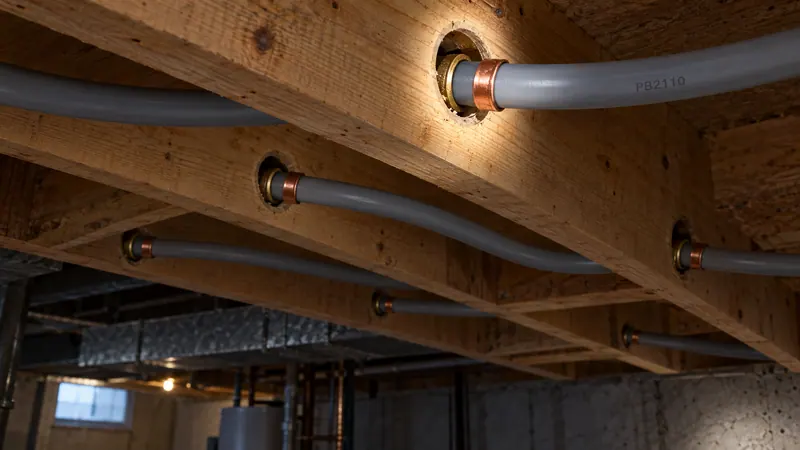
Identify your pipes
Photos, markings and a step-by-step check of the places poly-B hides.
Read more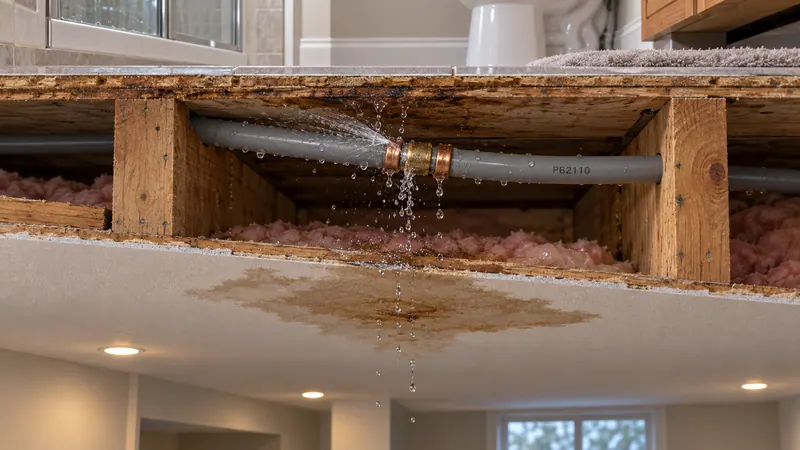
Understand the risk
How oxidation, heat, pressure and fittings combine, with an interactive degradation model.
Read more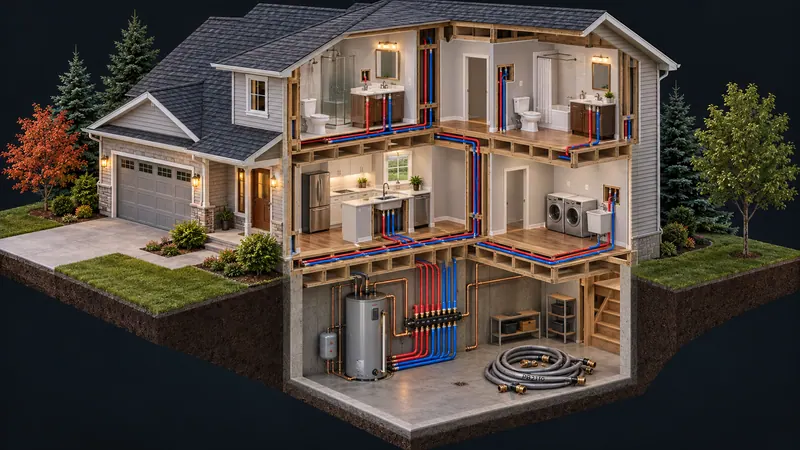
Price a replacement
An illustrative cost estimator plus the published provincial ranges and what they include.
Read more
Talk to your insurer
What underwriters ask about poly-B and how to prepare for a renewal condition.
Read moreSources
- Alberta Real Estate Association (B. Statt) — What should I know about Poly-B piping in homes? (January 16, 2025) · accessed 2026-09-28
- Westland Insurance — Has your broker asked if you have polybutylene (Poly-B) plumbing? · accessed 2026-09-28
- Government of Alberta — Polybutylene pressure water piping safety tips (2016) · accessed 2026-09-29
- Square One — Poly-B identification and homeowner guide · accessed 2026-09-29
- Alberta Municipal Affairs — Polybutylene (Poly-B) Pressure Water Piping fact sheet (Standata; archived copy) · accessed 2026-09-28
- Plastics Pipe Institute (L. MacNevin) — Plastic pressure pipe materials in US/Canada, presentation to the ICC 815 committee (October 30, 2023) · accessed 2026-09-28
- MyChoice — An insurance guide to Poly-B plumbing (updated September 24, 2026) · accessed 2026-09-28
- Lone Star Plumbing and Heating (Calgary) — Poly B pipe replacement · accessed 2026-09-28
- Plastics Pipe Institute — TN-31: differences between PEX and PB (2023) · accessed 2026-09-29
- Guide Perrier (Y. Perrier) — Tuyaux de polybutylène : est-ce une plomberie à risque ? (November 2015) · accessed 2026-09-28
- Siskinds LLP — Polybutylene pipe: Shell, DuPont and Celanese settlements · accessed 2026-09-28
- Premium Home Inspections (Prince George, B.C.) — Poly-B water supply piping · accessed 2026-09-28
- BFL CANADA Risk Control Engineering — Ask an Engineer No. 17: Polybutylene piping systems (March 2020), hosted by CHOA · accessed 2026-09-28
- Plastic Expert Group — Polybutylene (PB) pipes: three critical features affecting reliability (white paper) · accessed 2026-09-28
- Fujii et al. — Influence of residual chlorine and pressure on degradation of polybutylene pipe, Polymer Degradation and Stability 167 (2019) · accessed 2026-09-28
- Repipe Specialists — When was the polybutylene lawsuit deadline? · accessed 2026-09-28
- Wawanesa Insurance — How to create a water leak response plan · accessed 2026-09-28
- BC Housing — Maintenance Matters No. 21: Preventing water leaks in your home (February 2018) · accessed 2026-09-28
- Insurance Bureau of Canada — Know your home’s history and the potential issues lurking within its walls (June 25, 2025) · accessed 2026-09-28
- Jon Eakes — Fixit database: plastic supply water pipe lawsuits (Poly-B, Kitec, PEX fittings) · accessed 2026-09-28
- Inside Edge Home Inspections (Halifax) — Polybutylene supply pipe (October 3, 2021) · accessed 2026-09-28
- NB Power — What is Legionella? (water heater temperature) · accessed 2026-09-28
- Milani Plumbing, Heating & Air Conditioning — Beware of Poly-B plumbing (October 10, 2019) · accessed 2026-09-28
- Plastics Pipe Institute — TN-31: Differences between PEX and PB piping systems (2023 edition) · accessed 2026-09-28
- Armour Insurance (Alberta) — How to identify the type of plumbing your home uses · accessed 2026-09-28
- Newsfile — Urban Piping launches national Poly B replacement initiative (October 2, 2025) · accessed 2026-09-28
- Kingstree Plumbing (Alberta) — Replacing Poly B piping: guide for Canadian homeowners · accessed 2026-09-28
- Instant Plumbing & Heating (Calgary) — Why you ought to be concerned about your Poly-B piping (archived June 2024) · accessed 2026-09-28
- Your Guy Plumbing & Drainage (Lower Mainland, B.C.) — Poly-B plumbing replacement cost, 2022 guide · accessed 2026-09-28
- PatchBoyz (Ottawa) — Poly B plumbing replacement · accessed 2026-09-28
- BC Financial Services Authority — Material latent defects (selling a home) · accessed 2026-09-28
- Alberta Real Estate Association (B. Statt) — What is a material latent defect in real estate? (January 16, 2025) · accessed 2026-09-28
- Real Estate Council of Alberta — Property considerations: material latent defects · accessed 2026-09-28
- Alberta Municipal Affairs — Safety tips: Polybutylene (Poly-B) pressure water piping (August 2016) · accessed 2026-09-28
- CSA Group — Certification Notice, Plumbing Products No. 140 (December 3, 2001) · accessed 2026-09-28
- CSA Group — B137 Series-17 thermoplastic pressure piping compendium (B137.8 listed as withdrawn, July 2018) · accessed 2026-09-28
Updated 2026-09-29