Database · Submit a report
Submit a Report
Help build a Canadian evidence base on polybutylene plumbing by sharing your experience of a leak, a replacement or an insurance claim.
Why your report matters
Almost everything published about poly-B in Canada is an estimate, a contractor’s price list or one inspector’s view of their own town. What is missing is a record of what actually happens in real homes: which lines fail, at what age, with which fittings, what the repair and the repipe cost, and how insurers respond. Your report adds one verified line to that record.
Each submission is reviewed before it is used, and nothing you send appears publicly as an individual story. Once enough reviewed reports are in, the National Poly-B Incident Database will publish anonymised totals that other owners, buyers, condo boards and brokers can use.
Choose the report that fits
The form has three tabs. Send one report per event; if a leak led to both a claim and a repipe, you are welcome to file all three.
Report an Incident
A leak, burst pipe, failed fitting, visible degradation, or an insurance problem caused by having poly-B. Tell us when it happened, how serious it was and what the conditions were.
Share Replacement Cost
What your full or partial repipe cost, how long it took, what replaced the poly-B, and how the total split between labour, materials and drywall if you know.
Report Insurance Claim
How a water-damage claim involving poly-B turned out: approved, denied, partly paid or still pending, the amounts involved, and whether the insurer knew about the poly-B beforehand.
Have these handy before you start
None of these is essential except the required fields, but the more exact the details, the more useful the report.
0 of 7 checked
Report · Three tabs
Submit a report
Pick the tab that matches your experience and fill in what you know. Required fields are marked. Your submission will be reviewed before any of it is used in the public database, and your email, if you give one, is never published.
Getting the details right
Severity. Use your own judgement, with this as a guide: minor means a drip or damp spot caught early with little or no repair; moderate means some drywall, flooring or ceiling had to be repaired; severe means a room or more was damaged or the home needed professional drying; catastrophic means major damage across several rooms or floors, or time living elsewhere.
Water line. A failure on the pipe leaving the top of the water heater, or on the hot side under a sink, is a hot line. If you cannot tell, choose unknown rather than guessing.
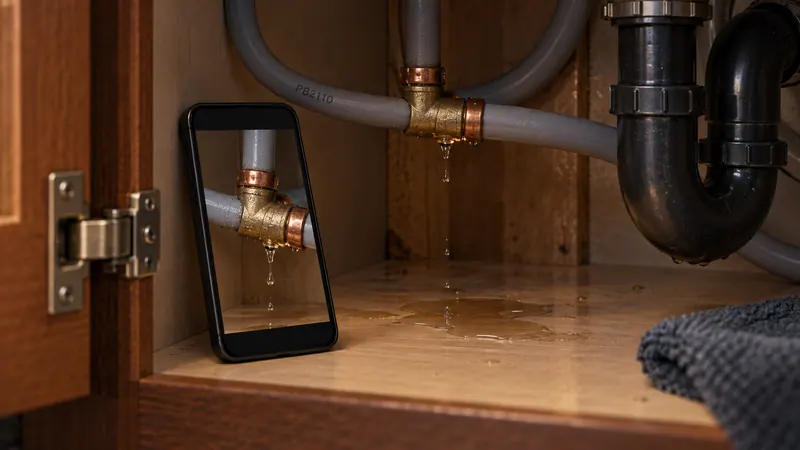
Fitting type. Copper and brass fittings look metallic, often with a copper-coloured crimp ring around the pipe. Grey plastic fittings that match the colour of the pipe are usually acetal, the material behind many early failures.12 Choose other plastic or unknown if neither description fits.
Costs. Enter what was actually paid, before any insurance payout, and leave a field blank rather than estimating a figure you do not know. Damage and claim amounts are published only in ranges.
What happens after you submit
You see a confirmation
Your submission is received and marked pending review. You can submit another report straight away or go to the database page.
A reviewer checks it
The HAUSE desk checks the report for completeness and consistency, and may email you if something needs clarifying and you left an address.
It is anonymised
Names and email addresses are separated out, location is reduced to city and postal prefix, and free text is edited to remove identifying details.
It joins the totals
Once approved, your report is added to the dataset that will be published as anonymised totals to help other Canadian homeowners.
Privacy and consent
Your personal information is kept confidential. Reports are published only as anonymised, aggregated figures, never with your name, email or street address. The optional email is used only to clarify your report. Contractor names and ratings are used for internal checks and are never published. Please leave policy numbers, claim numbers and other people’s names out of the text boxes. Before sending, you confirm the report is accurate to the best of your knowledge and agree to how it will be stored and used, as set out on the privacy page.
What a report is not
A report does not notify your insurer, open a claim, or put you on a contractor’s call list. It will not change how an insurer treats your home, and nothing in it is shared with an insurer in identifiable form.
If what you need is help replacing poly-B, request a quote instead: the desk replies with next steps and, where available and with your consent, a local contractor. If a pipe is leaking right now, close the nearest valve or the main shut-off and call a plumber first; the report can wait.3
Before or after you report
Questions · 4
Frequently asked questions
Will my report be published word for word?
No. Only totals are published, such as the number of reviewed hot-line failures in a province or the range of repipe costs for PEX. Short excerpts from descriptions may be used to illustrate a pattern, but only after they have been edited so that nobody can recognise the home or the people involved.
Can I report a leak from years ago?
Yes. Older incidents are useful as long as the date is roughly right and the details are from records or clear memory. Enter the best date you have and mention in the description if it is approximate.
I am not sure my pipe was poly-B. Should I still report?
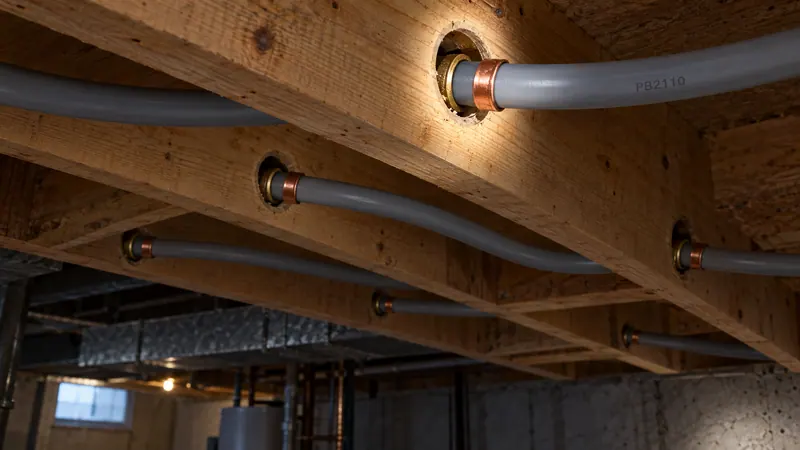
Report it if a plumber or inspector identified it as poly-B, or if the pipe was grey, flexible and marked PB2110. If you really cannot tell, say so in the description; the reviewer may ask a follow-up question or set the report aside.
Do I need to give my email?
No. It is optional and is used only if the reviewer needs to clarify something. Reports without an email are still reviewed, though a report that cannot be clarified is more likely to be set aside if it contains inconsistencies.
Sources
- Plastics Pipe Institute (L. MacNevin) — Plastic pressure pipe materials in US/Canada, presentation to the ICC 815 committee (October 30, 2023) · accessed 2026-09-28
- Alberta Municipal Affairs — Polybutylene (Poly-B) Pressure Water Piping fact sheet (Standata; archived copy) · accessed 2026-09-28
- MyChoice — An insurance guide to Poly-B plumbing (updated September 24, 2026) · accessed 2026-09-28


Updated 2026-09-28