01 / HAUSE POLY-B FIELD GUIDE
Poly-B pipes.
Know what’s
in your home.
The grey water lines found in many older Canadian homes. Learn to recognize the pipe, read its markings and understand what comes next.
Hot & cold water supply · Usually grey · Look for PB2110
Small. Flexible. Usually grey.
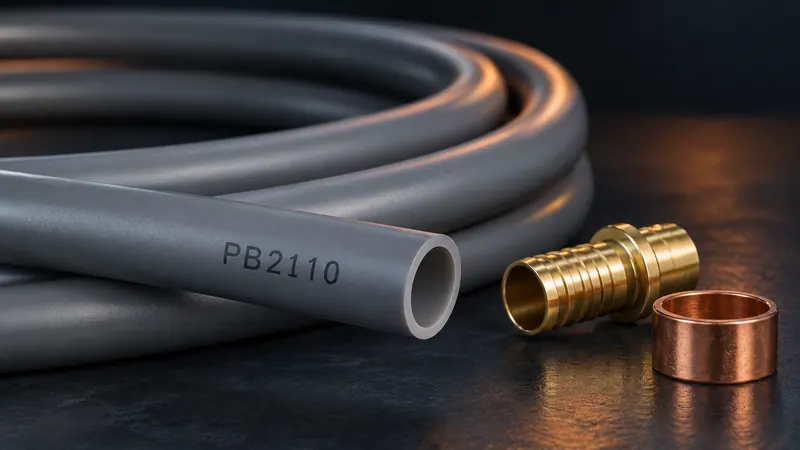
Poly-B is plastic water-supply tubing. Most is grey, although other colours exist. Colour alone cannot confirm the material.
Follow the tubing to a readable marking.Poly-B
Usually grey plastic.
Look for PB / PB2110.
PEX
May be red, blue or white.
Look for PEX.
Copper
Rigid metal tubing.
Copper-coloured surface.
Similar purpose. Different materials.
Poly-B and PEX are different plastics. Check the printed material name and ask a qualified plumber to confirm what is installed.
02 / THE IDENTIFYING CLUES
Grey tubing. Printed clues. Small connections.
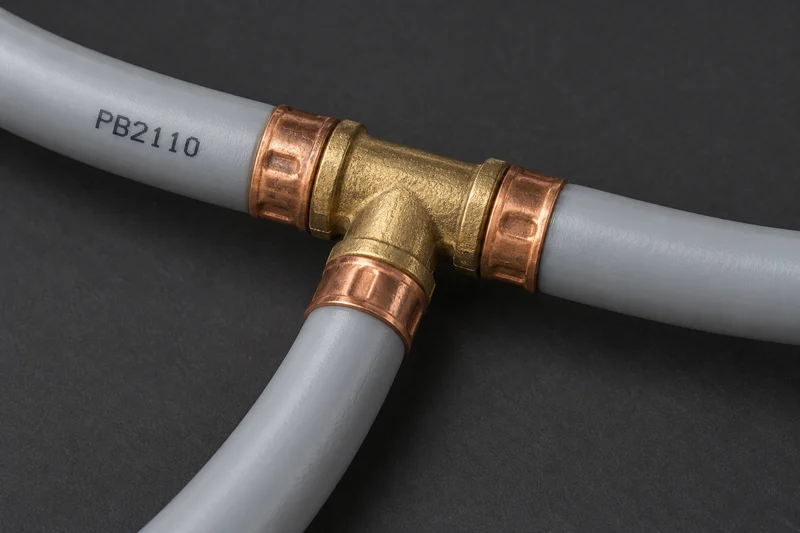
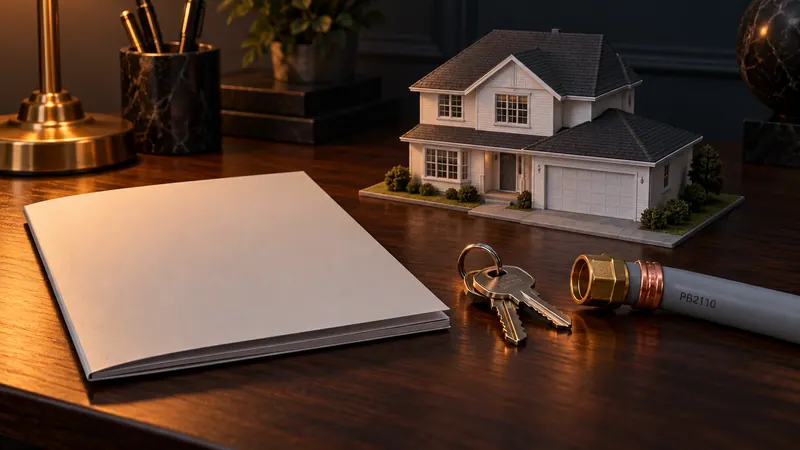
Polybutylene, usually called Poly-B, is flexible plastic piping used for hot and cold water supply. In Canadian homes it is commonly light grey, with markings such as PB2110 or CSA B137.8 along the tube.311
Copper-coloured crimp rings and brass or copper fittings are common in Alberta; plastic fittings were also used.3 A fitting is one clue. Read the tubing itself and have a qualified plumber confirm what remains.
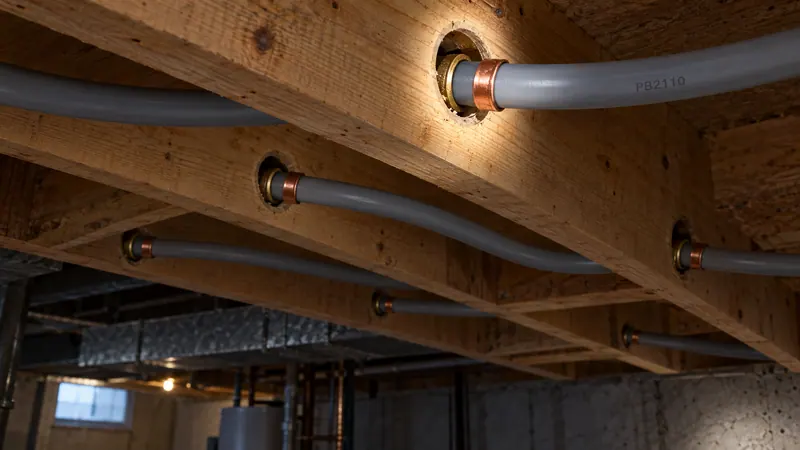
Start with safely accessible piping near the water heater, water meter, an unfinished basement ceiling or a sink. Photograph the tube, its printing and one connection without twisting or disturbing it. Open the full identification guide →
03 / FOLLOW THE WATER
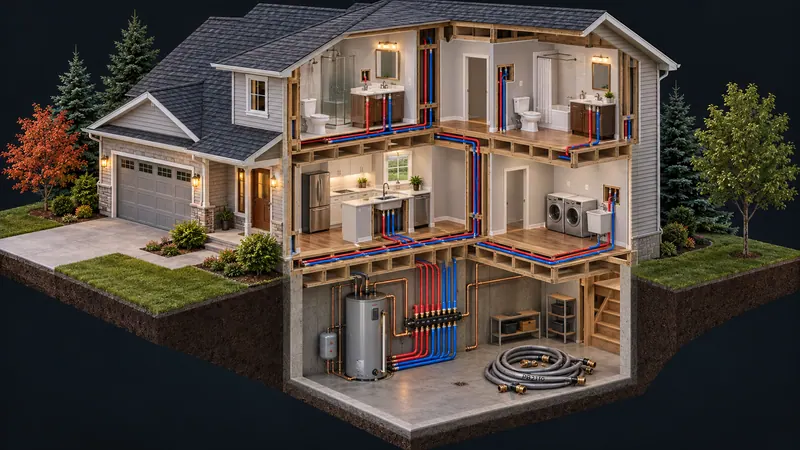
The pipe you see.
The system you don’t.
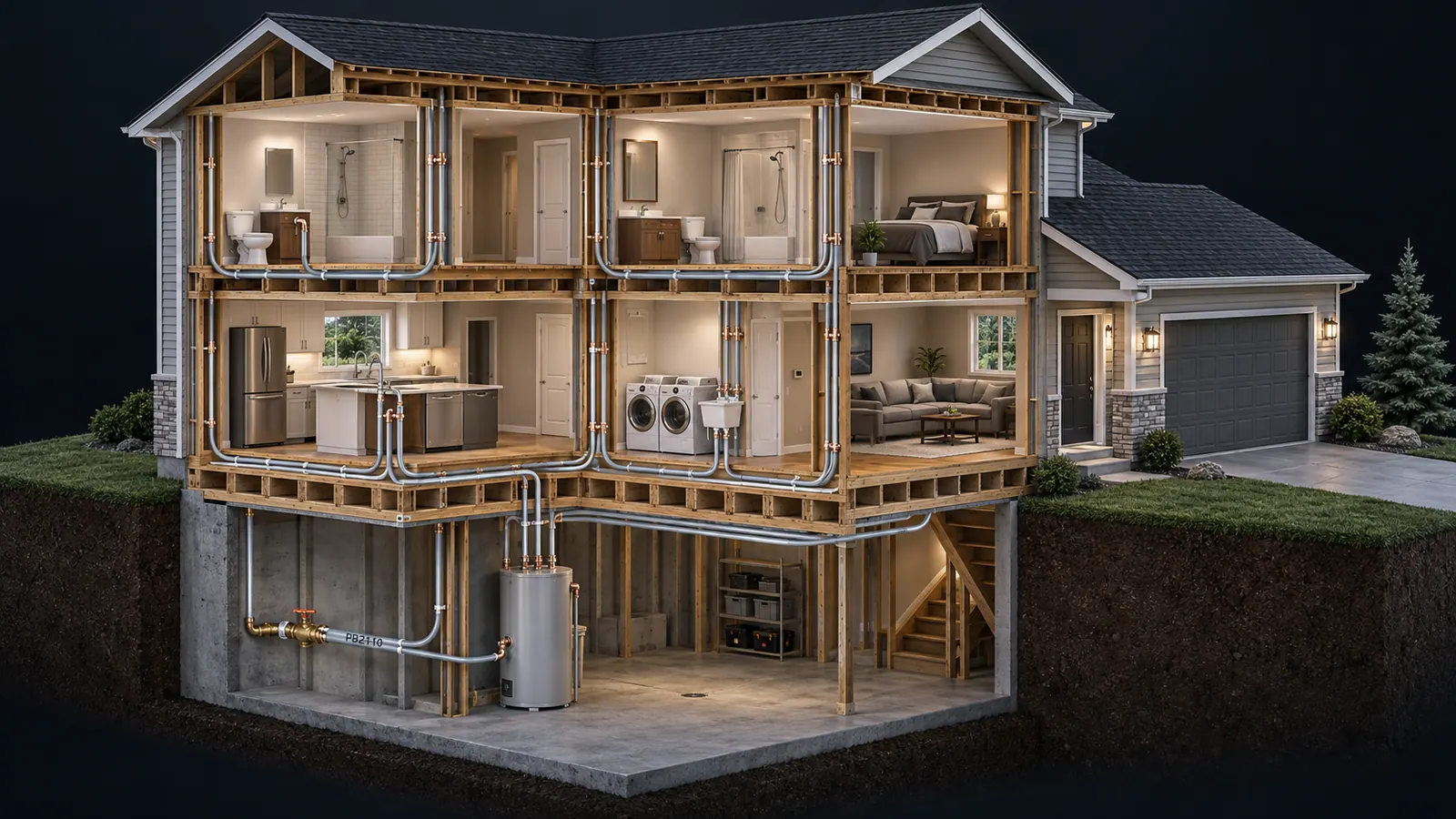
An exposed length is one clue. Grey supply lines can continue through walls and ceilings to the kitchen, bathrooms and laundry.
Where to look in your home ↗Conceptual illustration. Exposed piping does not confirm every concealed line.
04 / LOOK BEYOND THE COLOUR
Supply pipe, replacement pipe or drain?
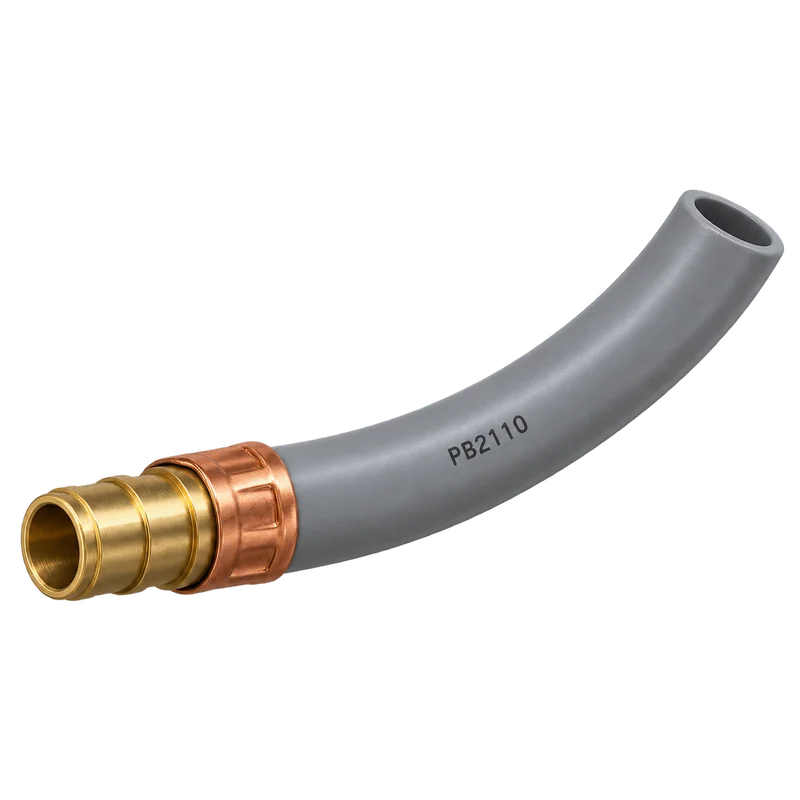
Poly-B supply tubing
Usually grey and flexible. Carries pressurized water to fixtures. Confirm the markings and the extent of the system.
Recognize Poly-B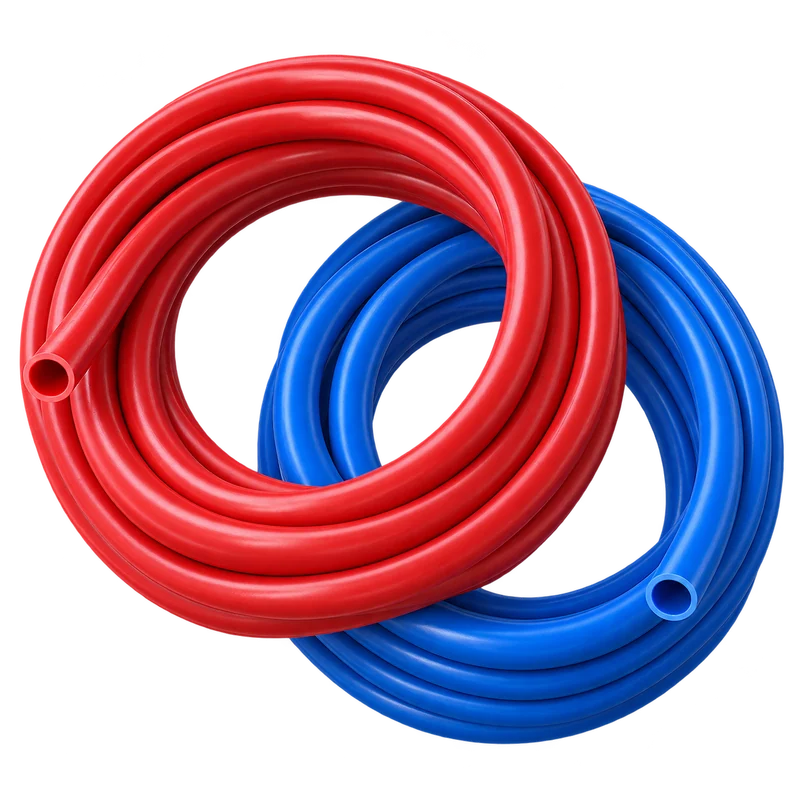
PEX supply tubing
Often red, blue or white, but other colours exist. Look for PEX in the printing. Similar crimp joints can appear on both materials.
Compare the materials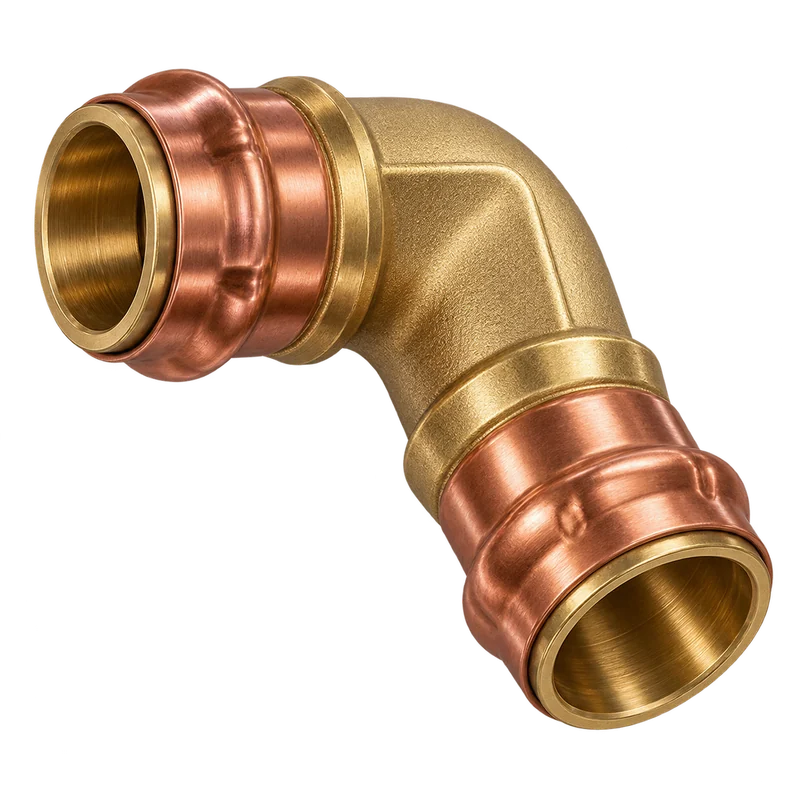
Copper & drain piping
Copper is metallic supply tubing. Large black ABS and sink traps serve drainage. Neither establishes what is hidden elsewhere.
See the visual guide05 / ASSESS THE WHOLE SYSTEM
A normal-looking pipe doesn’t tell the whole story.
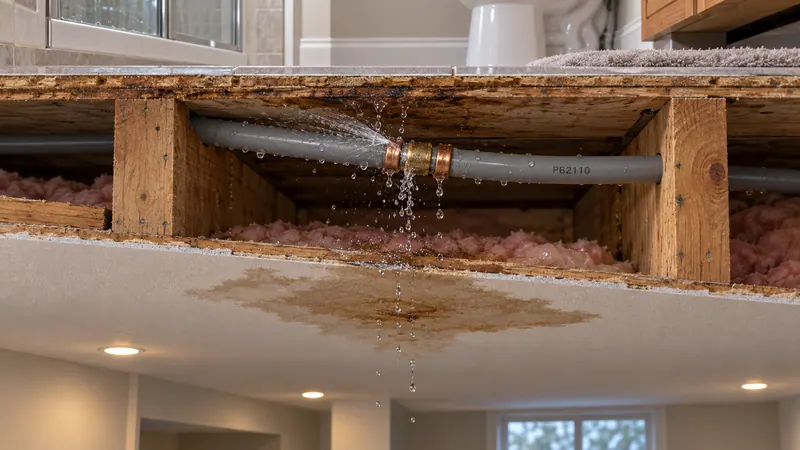
Poly-B can deteriorate internally and develop leaks at pipes or fittings. Heat, water chemistry and installation conditions contribute; the outside may still look normal.6 An inspection helps identify the material, visible condition and replacement scope. It cannot establish the remaining life of concealed tubing.
A local repair addresses a particular problem and leaves the other Poly-B in place. A complete repipe removes it from the replaced system. Ask for a clear scope covering concealed branches, connections, access openings, permits, testing and restoration. Understand the risks or plan a replacement.
06 / YOUR HOME, YOUR NEXT STEP
Tell us what you’ve found.
Share the age of the home, the piping you can see and what you are planning. HAUSE reviews the inquiry and confirms the next step and service availability. Have a report or pipe photos? Mention them in your notes; we can arrange a follow-up.
- 01A person reads itThe HAUSE desk reviews the age of the home, what you found and how urgent it is.
- 02You get a replyBy email from info@hause.ca or by phone from 403-679-3100, with practical next steps.
- 03Matched where availableWith your consent, your request goes to a local replacement contractor so they can quote.
- 04You decideNo obligation. Use the guides and the cost calculator to compare what you are quoted.
30-second check
Quick Poly-B Check
Answer three questions about your house and what you can see at the water heater. You get a likelihood, not a diagnosis.
What the model shows, in words
How the check works
You pick the year your home was built, say whether the plumbing was ever redone, and choose what the exposed pipe near your water heater or main shut-off looks like: flexible grey plastic with copper bands, red or blue plastic, white plastic, rigid copper, or nothing visible. The check combines those answers into one of four verdicts, from unlikely to very likely, and explains which answer moved the result most. Nothing you enter leaves your browser.
Why the build year matters
Alberta’s safety bulletin says a house built before 1975 will not have poly-B unless someone later renovated the plumbing. Homes finished between 1985 and 1997 sit in the busiest years of use. Late-1990s homes are not automatically clear: leftover stock kept being installed after production stopped, and a Quebec-amended edition of the national plumbing code still allowed the material until 2008. A re-plumb can add or remove it in any decade.
Why the pipe you see matters more
Build year only sets the odds. The pipe itself settles most cases. Poly-B is usually a light to medium grey flexible tube joined with copper crimp bands, and its printed line often includes the code PB2110 or the standard CSA B137.8. Modern PEX tends to be red, blue or white and prints “PEX” with its own standard. Rigid copper joined with solder is not plastic at all. The check weighs a visible grey pipe far above the date.
Reading the verdict
Unlikely means nothing you described points to poly-B. Possible means the age fits but you have not seen the pipe yet. Likely means you described grey flexible pipe in a home from the right era. Very likely means you also saw PB printing or copper crimp bands on grey tubing. Each result names the most useful next step, usually reading the print on one exposed length of pipe. The check cannot see inside walls or speak for your insurer, so treat it as a reason to look closer.
Timeline: The Polybutylene Story in Canada
From a promising low-cost material to a legacy that insurers and buyers now ask about. Dates are checked against court records, codes and standards bodies.
- 1970s
Introduction & Early Adoption
Shell developed polybutylene for pipe in the 1970s, and it entered the North American market as an alternative to copper for hot and cold water.89 CSA published the first edition of B137.8, the Canadian standard for polybutylene pressure piping, in 1977.10 Alberta dates its arrival in that province to the mid-1970s.3
- 1978–1985
Widespread Canadian Installation
Poly-B reached Canada for broad residential and commercial use as early as 1978. Builders liked it because it was cheap to make, light to ship, flexible around corners and needed no soldering.2 Quebec builders began using it in 1983.7
- 1985–1997
Peak Usage Period
The years 1985 to 1997 were the height of its appeal.2 A 2025 industry estimate counts more than 720,000 Canadian homes from that period that still carry it.4 CSA issued revised editions of B137.8 in 1986 and 1992, and from 1986 Quebec plumbers generally switched to copper fittings.107
- 1980s–1995
First Failures & Lawsuits
By the 1980s some systems were failing early through oxidative, brittle cracking, mostly at plastic fittings.11 In the United States the claims ended in class actions. In 1995 a Tennessee court approved the national Cox v. Shell settlement, under which Shell and Hoechst Celanese were to contribute US$950 million to replace leaking systems and pay for damage.12
- 1995–1998
Canadian Phase-Out Begins
The 1995 National Plumbing Code of Canada still accepted poly-B, but barred it from continuously circulating hot water lines and kept its joints out of concrete slabs.13 Shell stopped supplying pipe-grade resin to Canada and the United States in 1995–96, and by 1998 Canadian manufacturers had stopped producing the pipe.113 PEX and copper took over new work.
- 2002–2005
Canadian Class Actions
An Ontario action against Shell, DuPont and Hoechst Celanese produced a C$20 million Shell settlement, approved in April 2004, with claims due by June 18, 2005.15 A separate DuPont settlement paid part of the cost of re-plumbing systems with acetal fittings.15 Alberta’s notice gave May 31, 2005, or up to 15 years after installation, as the claims deadline.3 Those funds are closed.
- 2005
Removed From the National Code
The 2005 National Plumbing Code of Canada dropped the polybutylene article and its reference to CSA B137.8.1413 Codes are not retroactive, so pipe that was legal when installed can stay in service.3 Quebec’s amended code allowed poly-B until 2008.7
- 2010–2018
Standards Withdrawn
The American product standard ASTM D3309 was withdrawn in 2010.9 In Canada, CSA withdrew B137.8 in July 2018 and removed it from the B137 series.16
- 2020s
Current Situation
Poly-B installed from 1978 to 1997 is now roughly 29 to 48 years old. The Alberta REALTORS® Association says installations commonly last 20 to 30 years and reports insurers taking a harder line, from survey questions to higher premiums and occasional refusals.2 Buyers, sellers and lenders now treat poly-B as a line item to price.
Regional distribution
Regional Distribution
Where poly-B is known to be common, drawn only from published estimates. Provinces without a public count are shown as unknown rather than guessed.
What the model shows, in words
What the map shows
Each province is shaded by the published estimate of homes with poly-B, and a panel opens with the figure, who published it and when. The sources differ in year and method, and national totals range from about 700,000 to more than 720,000 homes. Where no public figure exists, the province is marked unknown. These are estimates based on construction patterns; actual poly-B presence varies by neighbourhood and by house, so confirm it at your own water heater.
Alberta
The Government of Alberta cites an unconfirmed estimate of about 148,000 Alberta homes with poly-B water systems. The same bulletin says Alberta installations mostly used copper or brass insert fittings with soft copper crimp rings, not the plastic fittings and aluminum bands linked to faster failures. A 2025 company estimate puts about 28,000 affected homes in Edmonton and describes Calgary as having the highest density relative to its market. Red Deer and Lethbridge also grew through the era.
British Columbia
The same 2025 company estimate places roughly 240,000 homes with poly-B in the Lower Mainland, which takes in Vancouver and Surrey. BC Housing’s leak-prevention bulletin singles out grey polybutylene for premature failure and warns that insurers may exclude related claims. Victoria and Kelowna are shown as centres that grew during the poly-B years, although no separate count has been published for Vancouver Island or the Interior.
Quebec
A 2015 Guide Perrier column estimates that about 225,000 Quebec houses have polybutylene supply lines. Quebec builders started using it in 1983, and from 1986 plumbers there generally joined it with copper fittings. The column reported few leak complaints in the province at the time. Montreal, Quebec City and Laval are marked as the largest centres, with the estimate applying province-wide rather than to any single city.
Ontario and the Prairies
No public count of poly-B homes was found for Ontario, Saskatchewan or Manitoba, so the map leaves them unshaded instead of inventing numbers. Poly-B was sold nationally and appears in Ontario court records through the Siskinds class action. Toronto, Mississauga, Ottawa and Hamilton, along with Regina, Saskatoon, Winnipeg and Brandon, are marked as major centres where homes from 1978 to 1997 are common and worth checking.
Poly-B help by city
Questions · 6
Frequently asked questions
Is grey pipe always Poly-B?
Where should I look first?
Safely accessible supply piping near the water heater, water meter, under sinks and in unfinished basements can offer clues. Look without turning valves unnecessarily, bending tubing or removing finished surfaces. Seeing copper at one fixture does not establish the entire system.
Is PEX the same as Poly-B?
No. PEX is cross-linked polyethylene, a different material with different standards. Both can be flexible and use crimp fittings; identify the tubing by its printing and professional assessment.9
Do metal fittings eliminate the concern?
What will my insurer require?
Requirements depend on your policy and insurer. Disclose what remains and ask for written guidance, particularly if only part of the system has been replaced. Replacement does not itself establish coverage. Prepare for the insurance conversation.
How do I compare replacement quotes?
Compare the exact piping removed, remaining Poly-B, replacement material, wall access, permits, testing, restoration, exclusions and taxes. A home-specific scope is more useful than a national average. Use the replacement planning guide.
Sources
- Westland Insurance — Has your broker asked if you have Polybutylene (Poly-B) plumbing? (Sept. 7, 2023) · accessed 2026-09-28
- Alberta REALTORS® Association — What should I know about Poly-B piping in homes? (Bryan Statt, Jan. 16, 2025) · accessed 2026-09-28
- Alberta Municipal Affairs — Safety Tips: Polybutylene (Poly-B) Pressure Water Piping (Aug. 2016) · accessed 2026-09-28
- Urban Piping via Newsfile — Urban Piping Launches National Poly B Replacement Initiative (Oct. 2, 2025) · accessed 2026-09-28
- Lone Star Plumbing & Heating (Calgary) — Poly B Pipe Replacement · accessed 2026-09-28
- BFL Canada Risk Control Engineering — Ask an Engineer, Issue 17: Polybutylene Piping Systems (Mar. 2020), hosted by CHOA · accessed 2026-09-28
- Guide Perrier — Yves Perrier, plomberie de polybutylène au Québec (Nov. 11, 2015) · accessed 2026-09-28
- Plastic Expert Group — Polybutylene (PB) Pipes: Unveiling Three Critical Features Affecting Reliability · accessed 2026-09-28
- Plastics Pipe Institute — TN-31: Differences Between PEX and PB Piping Systems for Potable Water (2023) · accessed 2026-09-28
- CSA — Certification Notice, Plumbing Products No. 140: B137 Series-99 (Dec. 3, 2001) · accessed 2026-09-28
- Plastics Pipe Institute — Plastic Pressure Pipe Materials in US/Canada, presentation to ICC 815 Committee (Oct. 30, 2023) · accessed 2026-09-28
- U.S. Court of Appeals, Fifth Circuit — Richard v. Hoechst Celanese Chemical Group, No. 02-41377 (Dec. 19, 2003), describing Cox v. Shell Oil Co. · accessed 2026-09-28
- National Research Council Canada — National Plumbing Code of Canada 1995, Article 2.5.9 · accessed 2026-09-28
- National Research Council Canada — National Plumbing Code of Canada 2005 · accessed 2026-09-28
- Siskinds LLP — Defective plastic pipes (polybutylene) used in plumbing and radiant heating · accessed 2026-09-28
- CSA Group — B137 Series-17, Thermoplastic pressure piping compendium (B137.8 withdrawn July 2018) · accessed 2026-09-28
- BC Housing — Maintenance Matters No. 21: Preventing Water Leaks in Your Home · accessed 2026-09-28
Keep going
Related guides
Updated 2026-09-30