Research · Library
Poly-B Research Library
Findings on polybutylene plumbing from governments, standards bodies, insurers, inspectors and contractors, each checked against its source, dated and sorted by topic and province.
What this library is for
Poly-B attracts a lot of confident writing and not much careful citation. Contractor blogs quote each other, press releases recycle round numbers, and figures drift as they are copied: an unconfirmed provincial estimate becomes a government count, a standard withdrawn in one year acquires another date, and a total for all water-damage claims is retold as a total for poly-B alone.
This library tries to reverse that drift. Each entry is a single finding, stated as narrowly as its source allows, with the organisation that published it, the date where one is given, and a link. Findings are grouped by topic and tagged by province so a homeowner in Kamloops, a broker in Calgary or a condo manager in Ottawa can find what applies to them without wading through the rest.
The library feeds the rest of the site. The FAQ, the risks guide, the replacement guide and the insurance guide draw their figures from here, so when an entry is corrected the change can be traced.
The library at a glance
Methods
How entries are chosen and checked
The starting point was every research row, FAQ citation and guide reference from the previous version of this site, merged and de-duplicated. Each claim was then traced to a page or document that could actually be opened. Where the original link had died, an archived copy from the Internet Archive was used if one existed, and the entry says so. Where nothing could be opened, the claim moved to the unverified list at the bottom of this page.
An entry counts as verified when the linked source, read on September 28, 2026, says what the entry says. Verified does not mean true in every house. A contractor’s price range is verified when the contractor really publishes it; it remains one firm’s experience in one market. A company press release is verified as a statement of what the company claims, and the entry says when no method is published.
Sources are weighed by type. Government fact sheets, standards bodies and technical institutes carry the most weight on codes, ratings and history. Insurers, brokers and the Insurance Bureau of Canada are the best evidence of underwriting positions, though those positions change and vary by company. Inspectors and plumbers describe what they see locally. Peer-reviewed laboratory work explains mechanisms but is run under accelerated conditions that a home never sees.
Numbers are reported as published, with units converted metric-first where trades think in inches. Dates show when the source was written or last updated, not when we read it. Nothing is averaged across sources, because the ranges measure different scopes: some include drywall, some exclude it, some cover a partial job.
Mechanism
The failure mechanism in one picture
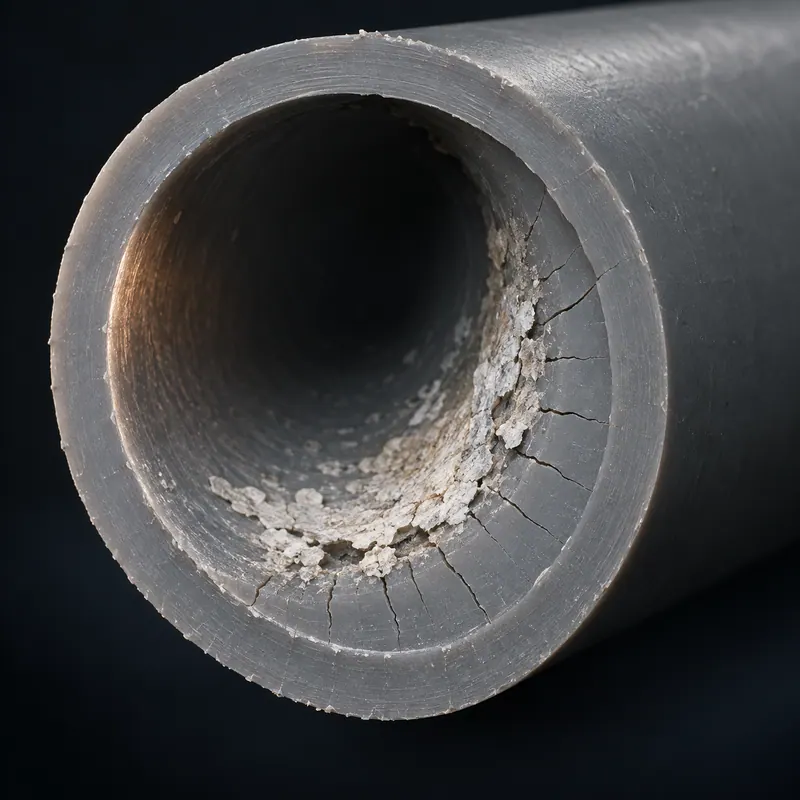
The strongest agreement in the literature is on how poly-B fails. Polybutylene’s backbone offers oxygen an easy target at every other carbon, stabilisers are slowly washed out by warm water, and once they are gone the inner skin of the pipe turns brittle and cracks outward under pressure.10
The early grey fittings failed for a related reason: they were moulded from polyacetal, not polybutylene, and polyacetal copes poorly with hot, chlorinated water.9 A 2019 laboratory study added that internal pressure, and not just disinfectant, accelerates the loss of antioxidant.11
What the literature cannot say is when a particular pipe will fail. Water chemistry, temperature, pressure, installation stress and fitting type all vary from house to house.
Synthesis
What the evidence says, topic by topic
Codes. The primary documents correct two dates that circulate widely. Alberta Municipal Affairs ties the delisting of poly-B to the 2005 National Plumbing Code, not 1997, and CSA records its B137.8 standard as withdrawn in July 2018, not 2005. Because codes are not retroactive, existing systems are not illegal.
Prevalence. There is no census of poly-B. The recurring national figure is an industry estimate of up to 700,000 homes; a 2025 company release claims just over 721,000. Alberta’s 148,000 is explicitly unconfirmed, and Quebec’s 225,000 comes from a 2015 consumer column. Treat all of them as orders of magnitude.
Service life. The best numeric evidence is American and from apartment buildings: an average failure age of 28.4 years where poly pipe was present. Canadian commentary suggests two to three decades for single-family systems without aggravating conditions. Pipe production stopped in 1998 and, outside Quebec’s later code window, installations wound down with it, so most poly-B in Canada has now been in service for close to thirty years or more.
Insurance. Published positions describe a menu rather than a rule: surcharges, replacement deadlines, higher deductibles, water-damage exclusions or declined applications. No source we opened gives a reliable insurer-by-insurer surcharge schedule, and one widely quoted table turned out to have no basis in the article it was attributed to.
Cost. Published ranges cluster between $5,000 and $15,000 for a detached house in Alberta, with wider national ranges of $3,000 to $25,000. Whether drywall and paint are included is the single biggest reason two quotes differ.
Regional differences. Quebec and Nova Scotia sources describe fewer failures than Alberta or British Columbia, usually crediting copper fittings and lower chlorine. Those accounts are older or anecdotal, and none is backed by claims data.
Law. The Canadian class settlements with Shell and DuPont closed to claims in 2005. No source supports the claim that a Supreme Court of Canada ruling freed insurers to refuse poly-B homes.
Codes & standards
What the codes and the CSA standard actually say, with dates corrected against the primary documents.
| Where | Finding | Source date |
|---|---|---|
| Canada | Poly-B is no longer listed as an acceptable plumbing piping material in the 2005 National Plumbing Code of Canada. Codes are not retroactive, so products accepted when installed remain acceptable unless they pose a health or safety hazard. Corrects the previous site’s claim that poly-B left the National Plumbing Code in 1997. 1 | undated fact sheet |
| Canada | Poly-B was CSA-certified and remained acceptable for potable water, but the 1995 National Plumbing Code of Canada stipulated it was not to be used for continuous circulating hot-water lines; some makers printed that warning on the pipe. 1 | undated fact sheet |
| Canada | Poly-B piping and fittings were intended for hot and cold water at pressures up to 100 psi (690 kPa) and temperatures up to and including 82 °C (180 °F). 1 | undated fact sheet |
| Canada | CSA lists B137.8, “Polybutylene (PB) piping systems for pressure applications”, as withdrawn in July 2018 and removed from the B137 series. Corrects the previous site’s claim that the standard was withdrawn in 2005. 2 | 2018 |
| Canada | A December 2001 CSA certification notice records that B137.7, polybutylene pipe for cold-water distribution, was withdrawn by the Technical Committee on Plastic Pressure Pipe in 1998, and that the fourth edition of B137.8 superseded editions of 1977, 1986 and 1992. 3 | 2001-12-03 |
| U.S. / international | The U.S. PB product standard ASTM D3309 was withdrawn in 2010, and PB has since been removed from plumbing and mechanical codes in the U.S. and Canada. PB remains in use elsewhere, typically made to ISO 15876. 4 | 2023 |
| Quebec | According to Guide Perrier, the National Plumbing Code as modified for Quebec permitted poly-B until 2008, and stock accumulated before production stopped in 1995 was installed through the late 1990s. 5 | 2015-11-11 |
7 verified entries.
Prevalence
How many homes are involved. Every figure here is an estimate; none is a count, and the source type is stated.
| Where | Finding | Source date |
|---|---|---|
| Alberta | Unconfirmed estimates put about 148,000 Alberta homes on poly-B water systems. Poly-B entered Alberta construction in the mid-1970s, and a home built before 1975 with no later plumbing work will not have it. The previous site presented 148,000 as a government count; the source calls it an unconfirmed estimate. 1 | undated fact sheet |
| Canada | Common industry estimates hold that poly-B is present in as many as 700,000 Canadian homes; it was most commonly used from the 1970s to around 1997. 6 | 2020-03 |
| Quebec | About 225,000 Quebec homes are estimated to have poly-B plumbing; the material was used in Quebec from 1983. 5 | 2015-11-11 |
| Canada | A 2025 company press release claims more than 721,000 affected homes built from 1985 to 1997, about 28,000 in Edmonton and around 240,000 in Vancouver’s Lower Mainland, and says Calgary has the highest density relative to market size. Marketing figures with no published method; recorded as what the release says, not as independent counts. 7 | 2025-10-02 |
| British Columbia | A Prince George inspector states poly-B went into more than 6 million U.S. homes and about 700,000 Canadian homes between 1978 and 1995. 8 | — |
5 verified entries.
Failure science
Why polybutylene and its early fittings failed, from standards bodies, laboratory work and a polymer-failure consultancy.
| Where | Finding | Source date |
|---|---|---|
| U.S. / international | By the 1980s some PB systems suffered premature oxidative (brittle) failures, many attributed to fittings moulded from polyacetal (POM), which has poor resistance to hot chlorinated water; makers switched to copper or brass fittings and introduced home-run manifolds to remove fittings from walls. 9 | 2023-10-30 |
| U.S. / international | No standardised test of resistance to hot chlorinated water existed for PB tubing; PEX must now show an extrapolated life of at least 50 years under ASTM F2023. PEX walls are up to 22 % thicker (SDR 9 versus SDR 11) at the same 100 psi / 82 °C rating. 4 | 2023 |
| U.S. / international | Polybutylene carries tertiary C–H bonds on alternating backbone carbons, which oxidise far faster than the CH₂ bonds dominating polyethylene. Added antioxidants are extracted by warm water; once depleted, the inner surface embrittles and cracks. 10 | — |
| U.S. / international | PB first crystallises in a Type II form and converts to Type I while coiled in storage, shrinking and taking a coil set; uncoiling then stresses the pipe. One manufacturer recommends a bend radius three times larger when reverse-bending coiled pipe. 10 | — |
| U.S. / international | Accelerated tests at 80 °C on PB pipe, with and without chlorine and internal pressure, found less residual antioxidant and stronger oxidation under pressure; the authors conclude that water pressure as well as dissolved chlorine promotes degradation. The previous site added that lifetime is shortened “even at low chlorine levels”; the abstract does not say this, so it is not repeated. 11 | 2019-09 |
| Canada | Degradation occurs on the inside wall, so a pipe can be badly weakened while looking normal outside; over-crimping of thin plastic connection pieces also caused micro-cracking and joint failures. 6 | 2020-03 |
| Quebec | In hydronic heating, oxygen permeating the PB wall rusted pumps, exchangers and other metal parts within three or four years; pipe produced from 1993 was modified to block oxygen. 5 | 2015-11-11 |
| U.S. / international | Owing to litigation and class settlements, Shell stopped supplying pipe-grade PB resin in Canada and the U.S. in 1995–96. PB2110 was the material code; U.S. brands included Qest and Vanguard. 9 | 2023-10-30 |
| Canada | Manufacturers stopped producing poly-B pipe in the spring of 1998 when suppliers suspended resin production. 1 | undated fact sheet |
9 verified entries.
Contractor figures are data points, not market rates
Several cost and failure entries come from companies that sell replacements. They are included because they are often the only published numbers for a city, and because homeowners will meet them anyway. Each is labelled with the firm and market it describes. For a price on your own home, the cost estimator gives an illustrative range and written quotes give the real one.
Service life
How long systems have tended to last. The only large dataset is American and multifamily, so read it as a benchmark.
| Where | Finding | Source date |
|---|---|---|
| U.S. / international | Fannie Mae and HUD studies put the useful life of domestic water systems in multifamily buildings at 30–50 years. SageWater’s data from 275 U.S. properties (June 2011–March 2022) show failures at 34.5 years on average, and 28.4 years at the 148 properties with poly pipe. 12 | 2022 |
| Alberta | Poly-B installations commonly last 20–30 years where properly installed without accelerating factors (high chlorine, UV, heat); the pipe usually does not change colour or appearance as it deteriorates. 13 | 2025-01-16 |
| Canada | Poly-B has no reliable universal lifespan; condition depends on installation, water pressure, water conditions, fitting types and leak history. 14 | 2026-09-24 |
3 verified entries.
Insurance
What insurers, brokers and industry bodies have published about underwriting poly-B homes.
| Where | Finding | Source date |
|---|---|---|
| Canada | An insurer may add a surcharge, set a deadline to replace poly-B, decline water-damage coverage, or decline property coverage. The article places poly-B in Canadian homes mostly from 1978 to 1997 and dates its removal from the plumbing code to 2005. The article contains no insurer-specific surcharge percentages or fixed replacement deadlines. 15 | — |
| Canada | Citing the Insurance Bureau of Canada, standard policies generally cover sudden and accidental escapes of water from plumbing, while predictable deterioration and maintenance are rarely covered; resulting water damage and pipe replacement are separate questions. 14 | 2026-09-24 |
| Canada | Owners who receive a replacement condition or non-renewal notice should calendar the deadline, ask what proof satisfies it, and look for other insurance before the policy expires. 14 | 2026-09-24 |
| Canada | IBC lists poly-B among risks of 1960s–1990s homes, citing reactivity with chlorine, UV sensitivity and heat, and says some insurers may have exclusions regarding it. 16 | 2025-06-25 |
| Canada | Insurers may decline a poly-B home or impose a higher premium or water-damage deductible; after a poly-B loss, owners can face large renewal increases or non-renewal. Insurers may ask the percentage of each pipe type in a partly updated home. 17 | 2026-09-14 |
| Alberta | An Alberta brokerage says a poly-B home can be insured but needs a certified plumbing inspection first; without one, coverage can be nearly impossible to obtain. 18 | — |
| Alberta | Insurers have taken a harder line, asking about poly-B in surveys and occasionally refusing coverage or charging more; some allow time to replace if flood detection or automatic shut-off valves are installed. 13 | 2025-01-16 |
| British Columbia | Grey polybutylene pipe has shown premature failure, and insurers may exempt claims relating to poly pipes or deny coverage; replacement with copper or PEX is recommended. 19 | 2018-02 |
| British Columbia | Poly-B with copper fittings is not usually an issue for insurers, but some B.C. insurers require removal regardless of installation method. 8 | — |
| Canada | Water-related events account for Wawanesa’s highest number and severity of personal property losses; its specialists say poly-B will leak eventually. 20 | — |
10 verified entries.
Replacement cost
Published price ranges. These are contractor or insurer figures for their own markets, not surveys.
| Where | Finding | Source date |
|---|---|---|
| Canada | Average whole-home replacement runs $3,000 to $25,000; access through floors and walls is a major cost, and replacement is often cheaper on the Prairies, where most homes have basements, than on the west coast. 17 | 2026-09-14 |
| Alberta | A Calgary contractor gives $5,000 to $15,000 as the usual price, driven by labour, interior access, home size, bathrooms and material. Poly-B fittings are no longer made, but failing sections can be transitioned to copper or PEX. 21 | — |
| Alberta | A Calgary contractor quoted $5,000 to $15,000 to replace all poly-B with PEX over two to three days, excluding drywall repair and repainting. 22 | 2024-06 (archived) |
| Alberta | An Edmonton-region contractor puts whole-home repipes at $10,000 to $20,000 and partial jobs from about $1,500, plus permits ($100–$500), inspection fees ($150–$300), drywall ($200–$800) and possible temporary accommodation. 23 | — |
| Ontario | An Ottawa contractor quotes $9,000 to $15,000 for the plumbing alone, $2,000 to $6,000 for drywall repair, and about two to three days for the pipe work. The same page claims buyers seek $20,000–$35,000 off and that insurers issue no new policies on poly-B homes; both are unverified contractor claims and are not repeated as fact. 24 | — |
| British Columbia | A 2022 Lower Mainland guide puts PEX replacement at $1,500 to $8,000+ and copper at $2,500 to $15,000+ for a two- to three-bathroom house, taking two to five days. The guide’s “over 95 % failure rate” claim is unsupported and not repeated. 25 | 2022 |
6 verified entries.
Maintenance & mitigation
Interim measures recommended by engineers, inspectors, utilities and insurers while a replacement is planned.
| Where | Finding | Source date |
|---|---|---|
| Canada | Owners of poly-B systems should run below 60 psi and at 55–60 °C to slow degradation; re-piping with a chemically stable material such as PEX is the only permanent fix. 6 | 2020-03 |
| Canada | Suggested steps: replace plastic fittings with copper or brass, avoid over-crimping, keep pressure at 40–60 psi, filter chlorine where levels are high, and do not set the water heater below BC Hydro’s 55 °C minimum. 17 | 2026-09-14 |
| British Columbia | A Lower Mainland plumber repeats the same mitigation list, estimates roughly 700,000 Canadian homes still have poly-B, and notes many systems ran without failure for 10–15 years. 26 | 2019-10-10 |
| British Columbia | Keep poly-B at least 46 cm (18 in) from a water heater and 15 cm (6 in) from a single-wall gas vent, support it every 0.9–1.2 m (3–4 ft), keep pressure at 40–60 psi, never use it with a boiler, and get three replacement estimates; partial repairs need conversion fittings to PEX or copper. The page also advises hot water no higher than 130 °F (54 °C), below the 60 °C storage temperature recommended against Legionella. 8 | — |
| British Columbia | Consider a pressure-reducing valve if supply exceeds 80 psi (IAPMO’s definition of excessive pressure); inspect water systems yearly, test shut-off valves, and install water sensors near appliances. 19 | 2018-02 |
| Canada | Know and test main and local shut-off valves, and consider a smart automatic shut-off on the main supply, which closes when it senses a continuous leak. 20 | — |
| New Brunswick | Canadian water heaters are factory-set to 60 °C to limit bacterial growth; Legionella grows best between 20 °C and 50 °C. Mixing or tempering valves, not a lower tank setting, reduce scald risk at the tap. 27 | — |
7 verified entries.
Legal history
The Canadian and U.S. class actions, their settlements and their deadlines.
| Where | Finding | Source date |
|---|---|---|
| Canada | Notice of the court’s final settlement approval appeared in Canadian print media on June 11, 2004; the poly-B claims deadline was May 31, 2005, or up to 15 years after installation. 28 | 2016-08 |
| Ontario | The Shell settlement provided $20 million, allocated by a point system, to owners of PB plumbing, yard service lines or hot-water heating systems; claims had to be postmarked by June 18, 2005. It received final Ontario approval on April 16, 2004, after certification had been denied on July 9, 2002. 29 | 2004 |
| Ontario | DuPont USA’s $30 million settlement paid 25 % of replumbing costs, and of prior repairs where a replumb was done, for systems with acetal insert fittings. A settlement with Hoechst Celanese was reached on June 14, 2010, subject to court approval. Celanese claim terms and deadline not verified. 29 | 2010 |
| Quebec | A Quebec class action begun in 1998 ended in a monetary settlement in 2004. 5 | 2015-11-11 |
| U.S. / international | In 1995 Shell Oil and DuPont were required to create a US$950 million fund to pay for pipe replacement in the United States. 5 | 2015-11-11 |
| U.S. / international | The U.S. Cox v. Shell Oil settlement was finalised in 1995, and its final claim-filing deadline was in 2009. 30 | — |
6 verified entries.
Real estate & disclosure
Disclosure rules and buying guidance from regulators and real estate associations.
| Where | Finding | Source date |
|---|---|---|
| Alberta | A material latent defect is a hidden physical problem that makes a property dangerous, unfit for its intended purpose or very costly to repair; sellers must tell their licensee, and licensees must disclose known material latent defects. 31 | — |
| Alberta | A seller cannot instruct a REALTOR® to withhold a material latent defect, and superficial work to conceal one can be fraudulent misrepresentation; defects that are major but visible, or hidden but minor, need not be volunteered, though agents cannot lie if asked. 32 | 2025-01-16 |
| British Columbia | Sellers have a common-law duty to disclose latent defects; licensees must also disclose defects involving great expense, local-authority notices and missing permits, and must stop trading services if told not to disclose. 33 | — |
| Alberta | A condition allowing the buyer to get professional advice and replacement quotes is recommended; if everything else works, poly-B should be a point of negotiation rather than a deal-breaker. 13 | 2025-01-16 |
| Quebec | Writing in 2015, Yves Perrier concluded that poly-B in a Quebec home should not be a reason to decline a purchase or reduce the price. 5 | 2015-11-11 |
| Canada | Buyers should confirm the pipe, request leak, repair and claim history, get a plumber’s inspection and itemised quote, and obtain an insurance quote that discloses poly-B. 14 | 2026-09-24 |
6 verified entries.
Condos & strata
Responsibilities and practical steps in shared buildings.
| Where | Finding | Source date |
|---|---|---|
| Canada | Condo buyers should establish which piping belongs to the unit and which is common property before assuming responsibility for repairs. 14 | 2026-09-24 |
| British Columbia | Strata corporations are responsible for pipe maintenance in common property and can gain economies of scale by contracting one provider; owners need written strata permission before plumbing alterations and must follow bylaws when shutting off water. 19 | 2018-02 |
2 verified entries.
Regional experience
Why failure experience differs between regions, as described by commentators and local inspectors.
| Where | Finding | Source date |
|---|---|---|
| Canada | Few acetal in-line fittings were used in Canada, many U.S. failures occurred in hot southern mobile-home roof spaces, and Canadian chlorine levels are lower; reader reports later suggested poly-B is aging poorly in Calgary as well. 34 | — |
| Quebec | Quebec’s municipal chlorine is generally under 2 ppm; copper fittings have been used since 1986; the CMMTQ recorded few leaks and the ACQC few complaints, and Desjardins applied no poly-B surcharge at the time of writing. 5 | 2015-11-11 |
| Nova Scotia | A Halifax inspector finds local poly-B systems usually have quality copper fittings and reports that plumbers see failures as rare, while noting heavily chlorinated Dartmouth water before 1999 and that some insurers charge higher premiums. 35 | 2021-10-03 |
| Alberta | Alberta installations primarily used copper or brass insert fittings and soft copper crimp rings, not the plastic inserts with aluminium or copper bands reported to fail more often. 1 | undated fact sheet |
4 verified entries.
Index by province
How many verified findings apply to each jurisdiction, and on which topics. National entries apply everywhere in Canada unless a provincial entry says otherwise.
| Jurisdiction | Findings | Topics covered |
|---|---|---|
| National (Canada) | 24 | Codes & standards, Prevalence, Failure science, Service life, Insurance, Replacement cost, Maintenance & mitigation, Legal history, Real estate & disclosure, Condos & strata, Regional experience |
| Alberta | 11 | Prevalence, Service life, Insurance, Replacement cost, Real estate & disclosure, Regional experience |
| British Columbia | 9 | Prevalence, Insurance, Replacement cost, Maintenance & mitigation, Real estate & disclosure, Condos & strata |
| Ontario | 3 | Replacement cost, Legal history |
| Quebec | 6 | Codes & standards, Prevalence, Failure science, Legal history, Real estate & disclosure, Regional experience |
| Nova Scotia | 1 | Regional experience |
| New Brunswick | 1 | Maintenance & mitigation |
| U.S. / international | 10 | Codes & standards, Failure science, Service life, Legal history |
Saskatchewan, Manitoba, Prince Edward Island, Newfoundland and Labrador and the territories have no province-specific verified findings yet.
Claims we could not verify
These statements appeared on the previous version of this site or are widely repeated elsewhere. We tried to trace each one and failed, or found that the named source says something different. They are listed so you can recognise them, not so you can rely on them.
| Claim | Where it came from | What we found |
|---|---|---|
| Hourly plumbing rates for poly-B work of $75–$100 in British Columbia, $70–$90 in Alberta, $65–$85 in Saskatchewan and $60–$80 in Manitoba. | Urban Piping — labour-cost article (original URL now redirects to a service page) | The cited article no longer exists; the URL redirects to a service page and no archive was found. |
| Between 650,000 and 750,000 Canadian homes still contain poly-B, and it was used in 20–25 % of homes built in the 1980s and early 1990s. | Daylight Home Inspections — Polybutylene pipes in Calgary (domain no longer active) | The inspector’s domain is parked and no archived copy was found. |
| More than 200,000 British Columbia homes, and about 700,000 Canadian homes, have poly-B. | Safe Warm Dry — Poly-B plumbing (page returns 404) | The cited page returns 404 and no archived copy was found; the 700,000 national figure is supported elsewhere. |
| Over one million Canadian homes have poly-B plumbing. | Previous Polybutylene.ca content (no source recorded) | No source exists for this figure; sourced estimates are 700,000 (industry) and 721,000 (a 2025 company release). |
| Repipes cost $4,000 to $15,000+, with material at $0.50–$2 per linear foot for PEX and $2–$8 for copper. | Whyte Plumbing (B.C.) — Signs you need a Poly-B pipe replacement (page no longer available) | The page is gone and its archived copy renders no text. |
| Dr. Pipe estimates Ontario poly-B replacement at $3,000 to $25,000. | Dr. Pipe (Ottawa) — Poly B plumbing replacement services | The current Dr. Pipe page gives no price range; the $3,000–$25,000 figure is Square One’s. |
| Lower Mainland video estimates cite $9,000 to $12,000 for average homes. | Previous Polybutylene.ca content (no source recorded) | The previous site named a YouTube estimator without a link; not traceable. |
| Poly-B-related water-damage claims rose 35 % between 2023 and 2024. | Previous Polybutylene.ca content (no source recorded) | Attributed to an unnamed “2025 risk report” with no link; no such report was found. |
| Insurer-specific surcharges (for example 15–25 %, 20–30 % or 15–35 % by company), a two-year replacement deadline and annual inspection reports. | Westland Insurance — Has your broker asked if you have polybutylene (Poly-B) plumbing? | Attributed to Westland Insurance by the previous site, but the Westland article contains none of these figures. |
| Most insurers expect full replacement within one to three years of a certified inspection. | Previous Polybutylene.ca content (no source recorded) | No source found; insurer conditions vary and are set case by case. |
| Poly-B water-damage claims reached $130 million across Canada in one year. | Newsfile — Urban Piping launches national Poly B replacement initiative (October 2, 2025) | The release actually says Canadian water-damage claims totalled $130 million with poly-B “contributing significantly”; no breakdown or source is given. |
| A 2005 Supreme Court of Canada class action deemed polybutylene inadmissible for indemnity insurance. | Newsfile — Urban Piping launches national Poly B replacement initiative (October 2, 2025) | No such Supreme Court of Canada decision was found; the documented Canadian class actions were settled in provincial courts. |
| Poly-B was banned by the National Plumbing Code in 1997. | PatchBoyz (Ottawa) — Poly B plumbing replacement | Contradicted by Alberta Municipal Affairs, which dates the delisting to the 2005 National Plumbing Code; no 1997 code edition was found. |
| CSA B137.8 was withdrawn in 2005. | Previous Polybutylene.ca content (no source recorded) | Contradicted by CSA, which lists the withdrawal as July 2018. |
| The Cox v. Shell (Tennessee, about US$950 million, 1995) and Spencer v. Shell (Alabama) settlements resolved U.S. claims, as summarised in a Fifth Circuit opinion. | U.S. Court of Appeals, Fifth Circuit — opinion 02-41377 (URL returns 404) | The opinion URL returns 404; the Cox figures are supported by other sources, the Spencer reference is not. |
| Insurance guides say water-damage risks are rising in Atlantic Canada as homes age. | MyChoice — An insurance guide to Poly-B plumbing (updated September 24, 2026) | Attributed to MyChoice by the previous site; the current MyChoice article does not say this. |
If you hold the original source for any of these, send it to the HAUSE desk (contact details are in the footer) and the entry will be reviewed.
Gaps
What nobody has published yet
The most important missing number is a Canadian failure rate: how many poly-B systems leak in a given year, broken down by province, fitting type, water temperature and age. Insurers hold claims data but do not publish it by pipe material, and plumbers see only the homes that call them. Without that, every regional comparison in this library rests on commentary rather than counts.
We are also short of province-specific evidence for Saskatchewan, Manitoba and most of Atlantic Canada, and of any systematic record of how insurers actually responded when owners disclosed poly-B at renewal.
The National Poly-B Incident Database exists to start filling those gaps. It collects individual reports of leaks, replacements and insurance outcomes, reviews them, and will publish anonymised totals once enough reviewed reports are in. If you have a story, submit a report.
Citing and correcting the library
Cite the original source rather than this page wherever you can; the links in the tables and the numbered list below point to it. If you find an entry that misstates its source, or a newer publication that supersedes one, tell us through the desk and include the link. Corrections are dated in the entry notes so readers can see what changed.
Put the research to work
- Frequently asked questionsPlain-language answers built from these findings
- Why poly-B failsThe mechanism, with an interactive degradation model
- Replacement costsPublished ranges and an illustrative estimator
- Insurance and poly-BWhat underwriters ask and how to prepare
- National Poly-B Incident DatabaseHelp build the Canadian evidence base
Sources
- Alberta Municipal Affairs — Polybutylene (Poly-B) Pressure Water Piping fact sheet (Standata; archived copy) · accessed 2026-09-28
- CSA Group — B137 Series-17 thermoplastic pressure piping compendium (B137.8 listed as withdrawn, July 2018) · accessed 2026-09-28
- CSA Group — Certification Notice, Plumbing Products No. 140 (December 3, 2001) · accessed 2026-09-28
- Plastics Pipe Institute — TN-31: Differences between PEX and PB piping systems (2023 edition) · accessed 2026-09-28
- Guide Perrier (Y. Perrier) — Tuyaux de polybutylène : est-ce une plomberie à risque ? (November 2015) · accessed 2026-09-28
- BFL CANADA Risk Control Engineering — Ask an Engineer No. 17: Polybutylene piping systems (March 2020), hosted by CHOA · accessed 2026-09-28
- Newsfile — Urban Piping launches national Poly B replacement initiative (October 2, 2025) · accessed 2026-09-28
- Premium Home Inspections (Prince George, B.C.) — Poly-B water supply piping · accessed 2026-09-28
- Plastics Pipe Institute (L. MacNevin) — Plastic pressure pipe materials in US/Canada, presentation to the ICC 815 committee (October 30, 2023) · accessed 2026-09-28
- Plastic Expert Group — Polybutylene (PB) pipes: three critical features affecting reliability (white paper) · accessed 2026-09-28
- Fujii et al. — Influence of residual chlorine and pressure on degradation of polybutylene pipe, Polymer Degradation and Stability 167 (2019) · accessed 2026-09-28
- SageWater — Polybutylene pipes (project data June 2011–March 2022) · accessed 2026-09-28
- Alberta Real Estate Association (B. Statt) — What should I know about Poly-B piping in homes? (January 16, 2025) · accessed 2026-09-28
- MyChoice — An insurance guide to Poly-B plumbing (updated September 24, 2026) · accessed 2026-09-28
- Westland Insurance — Has your broker asked if you have polybutylene (Poly-B) plumbing? · accessed 2026-09-28
- Insurance Bureau of Canada — Know your home’s history and the potential issues lurking within its walls (June 25, 2025) · accessed 2026-09-28
- Square One Insurance — Poly-B plumbing: the complete guide (updated September 14, 2026) · accessed 2026-09-28
- Armour Insurance (Alberta) — How to identify the type of plumbing your home uses · accessed 2026-09-28
- BC Housing — Maintenance Matters No. 21: Preventing water leaks in your home (February 2018) · accessed 2026-09-28
- Wawanesa Insurance — How to create a water leak response plan · accessed 2026-09-28
- Lone Star Plumbing and Heating (Calgary) — Poly B pipe replacement · accessed 2026-09-28
- Instant Plumbing & Heating (Calgary) — Why you ought to be concerned about your Poly-B piping (archived June 2024) · accessed 2026-09-28
- Kingstree Plumbing (Alberta) — Replacing Poly B piping: guide for Canadian homeowners · accessed 2026-09-28
- PatchBoyz (Ottawa) — Poly B plumbing replacement · accessed 2026-09-28
- Your Guy Plumbing & Drainage (Lower Mainland, B.C.) — Poly-B plumbing replacement cost, 2022 guide · accessed 2026-09-28
- Milani Plumbing, Heating & Air Conditioning — Beware of Poly-B plumbing (October 10, 2019) · accessed 2026-09-28
- NB Power — What is Legionella? (water heater temperature) · accessed 2026-09-28
- Alberta Municipal Affairs — Safety tips: Polybutylene (Poly-B) pressure water piping (August 2016) · accessed 2026-09-28
- Siskinds LLP — Polybutylene pipe: Shell, DuPont and Celanese settlements · accessed 2026-09-28
- Repipe Specialists — When was the polybutylene lawsuit deadline? · accessed 2026-09-28
- Real Estate Council of Alberta — Property considerations: material latent defects · accessed 2026-09-28
- Alberta Real Estate Association (B. Statt) — What is a material latent defect in real estate? (January 16, 2025) · accessed 2026-09-28
- BC Financial Services Authority — Material latent defects (selling a home) · accessed 2026-09-28
- Jon Eakes — Fixit database: plastic supply water pipe lawsuits (Poly-B, Kitec, PEX fittings) · accessed 2026-09-28
- Inside Edge Home Inspections (Halifax) — Polybutylene supply pipe (October 3, 2021) · accessed 2026-09-28
Updated 2026-09-28