Coverage · Disclosure · Renewal
Ask your insurer. Keep the answer.
Coverage for a Poly-B home depends on the policy and the insurer. Prepare the plumbing details, ask specific questions and get any conditions confirmed in writing.
Tell your insurer about poly-B
Insurers increasingly ask about pipe material on applications and renewal questionnaires, and some have refused to insure or charged more when poly-B is present.2 Answer every plumbing and loss-history question accurately and keep a copy of what you submitted.7 If you are unsure what the pipe is, have a plumber look before you answer.1
The short version
How insurers treat poly-B
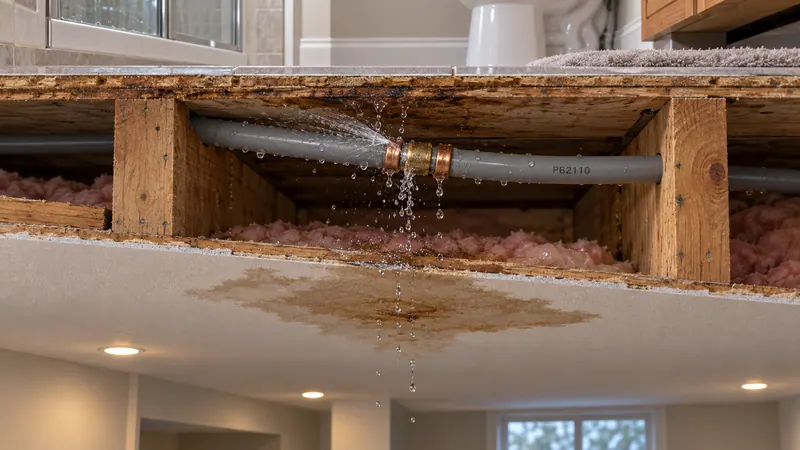
Insurers care about plumbing because water damage is one of the most frequent and costly home claims, and they price the chance of a leak into every policy.114 Poly-B worries them because it degrades from the inside, often invisibly, and fails under ordinary water pressure.15
Westland Insurance, a Canadian brokerage, lists what an insurer may do once it knows a house has poly-B:1
- add a surcharge to the premium;
- set a deadline for replacing the pipe;
- decline to offer water-damage coverage;
- decline to offer any property coverage at all.
The Alberta Real Estate Association says the industry has taken a harder line as late-1990s installations approach the end of their economic life, with some insurers giving homeowners time to replace if they install flood detection or automatic shut-off valves.2 The Insurance Bureau of Canada, the national industry association, says more simply that some insurers may have exclusions for poly-B and that you should ask your own representative.4
The outcome for a given house depends on the insurer, the province, the home, its loss history, how the poly-B was installed and guidelines that keep changing.7 That is why the tables below describe reported positions rather than rules.
Six questions to send your broker
Use the answers to understand your actual policy before a purchase, renewal or replacement.
0 of 6 checked
Map
Insurance climate by province
Tap a province to see what published sources say about insuring a poly-B home there, and the questions to take to your broker. Reported positions; confirm with your insurer or broker.
What the model shows, in words
What the colours mean
Each province and territory is shaded by the tone of the sources we could find, not by any rule an insurer has published. Darker shading means brokers, an insurer or a realtor association describe surcharges, replacement deadlines or refusals there. A middle shade marks places where guidance is thin and brokers decide file by file. The lightest shade is Quebec, where a dated source reports little insurer concern. Grey marks the territories, where we found nothing published at all.
Alberta and British Columbia
These two provinces have the most published commentary. Alberta’s realtor association says insurers ask about poly-B in their questionnaires and sometimes refuse coverage or charge more, while allowing time to replace in some cases if leak detection is installed. An Alberta insurance agency says a certified plumbing inspection comes before any offer. In British Columbia, BC Housing warns that claims relating to poly pipes may be exempted, and strata owners also have to sort out who is responsible for which pipe.
Ontario, the Prairies and Atlantic Canada
Ontario sources describe a case-by-case market: the Insurance Bureau of Canada notes that some insurers exclude poly-B, and Ottawa renovation firms report difficulty placing coverage, though they sell replacements themselves. Saskatchewan and Manitoba have almost no province-specific guidance, so national broker commentary applies. In Nova Scotia, a Halifax inspector reports copper-fitted systems that rarely fail and some insurers that still charge more. New Brunswick, Prince Edward Island and Newfoundland and Labrador have no published insurer position we could find.
Quebec is the outlier
A 2015 Quebec renovation guide estimates about 225,000 homes in the province have poly-B and reports little evidence of early failure. It links that record to low chlorine in municipal water and to copper fittings used since 1986, and says Desjardins applied no risk surcharge at the time. The article is more than ten years old, so the map marks Quebec as low concern with a date warning rather than as a promise of cover.
Using the map with your broker
Each province panel ends with a short list of questions written for that market: whether a leak detector buys time, what a plumber’s letter must say, how strata responsibility works, or whether a surcharge ends right after replacement. Take those questions to a licensed broker, ask for the answers in writing, and keep them with your policy. If you are buying, get the insurer’s decision before your financing and inspection conditions expire.
Provincial variations
A plain-text version of the map. Reported positions — confirm with your insurer or broker.
| Province | Climate | What published sources say |
|---|---|---|
| Alberta | Tightening | Insurers ask about poly-B and occasionally refuse or charge more; some allow time to replace if flood detection or automatic shut-off valves go in.2 A certified plumbing inspection is expected before a poly-B home is insured.3 |
| British Columbia | Tightening | Insurers may surcharge, set deadlines or decline cover.1 BC Housing warns claims relating to poly pipes may be exempted.11 A Vancouver-area plumber reports tighter underwriting since about 2018.16 |
| Saskatchewan | Case by case | No province-specific guidance found; national broker commentary applies.1 |
| Manitoba | Case by case | Guidance is limited; expect possible conditions or a premium change.1 |
| Ontario | Case by case | Some insurers may have exclusions for poly-B.4 Ottawa renovation firms report difficulty finding new policies, a claim no insurer has published.17 |
| Quebec | Low concern (2015) | About 225,000 homes; little evidence of early failure; Desjardins reported no risk surcharge in 2015.12 |
| New Brunswick | Case by case | No insurer guidance found; confirm before firming a purchase. |
| Nova Scotia | Case by case | A Halifax inspector reports copper-fitted systems that rarely fail and some insurers that still charge higher premiums.13 |
| Prince Edward Island | No data | No insurer publication found; ask the broker to confirm in writing. |
| Newfoundland and Labrador | No data | No insurer publication found. |
| Yukon, Northwest Territories, Nunavut | No data | No published guidance found. |
Insurer lookup: reported positions
Reported positions — confirm with your insurer or broker. These are the insurers the earlier version of this site listed. We looked for each company’s own published position; where we found none, the row says so. Surcharge percentages that appeared here before could not be traced to any source and have been removed.
| Insurer | Provinces listed | Reported stance | What we found | Insurer’s own statement? |
|---|---|---|---|---|
| Intact Insurance | AB, BC, ON, QC | Varies | No Intact statement on poly-B found. Brokers describe surcharges, deadlines or declined water cover across the market.1 | No |
| Aviva Canada | AB, BC, ON | Varies | No Aviva statement on poly-B found; treat any limit as unconfirmed until it appears in your own documents. | No |
| TD Insurance | AB, BC, ON, QC | Varies | No poly-B statement found. TD’s 2010 buyer advice says outdated plumbing can affect premiums and eligibility, and suggests sharing the home inspection with your insurer.14 | General only (2010) |
| Desjardins Insurance | QC | No surcharge reported (2015) | A 2015 Quebec guide reports Desjardins applied no risk surcharge for poly-B.12 | Reported secondhand |
| Wawanesa Insurance | AB, BC, MB, ON | Varies | Its prevention blog says poly-B will eventually need replacing and recommends an automatic shut-off valve; no underwriting rule published.10 | Yes (blog, 2024) |
| Co-operators | AB, BC, ON, SK | Varies | No Co-operators statement on poly-B found. | No |
| Atlantic region insurers | NB, NS, PE, NL | Varies | No insurer statement found; a Halifax inspector says some insurers may charge higher premiums.13 | No |
A contractor’s description of an insurer does not establish the terms of your policy. Ask the insurer or broker to confirm your eligibility, exclusions and any deadline in writing.
What underwriters look at
Insurers rarely publish their poly-B rules, but broker and insurer guides agree on the details that raise or lower concern.
Leak history
Stains, corrosion, a repaired joint or a past water claim matter more than the pipe label; expect questions and a plumber’s assessment.7
Fittings and crimps
Plastic insert fittings and questionable crimps raise concern. Alberta installations mostly used copper or brass fittings with copper crimp rings.79
Hot-water recirculation
The 1995 National Plumbing Code barred poly-B from continuously circulating hot-water lines, so a recirculation loop on poly-B is worth checking.97
Pressure and routing
High pressure and sharp bends stress the pipe. A pressure reading and a look at accessible runs answer the question.7
Mixed materials
After a partial replacement, insurers may want the share of each pipe type and proof of which runs changed.87
Age of the house
Insurers especially want to know the plumbing type in homes built between the early 1970s and the early 1990s.8
Inspection
Armour Insurance, an Alberta agency, says a certified plumbing inspection is needed before a poly-B home can be insured.3
Records
No records and inaccessible pipe leave the underwriter guessing; an inspection and an itemized repipe estimate help.7
Documentation that helps
Gather these before you apply, renew or list the house. They answer the questions an underwriter or a buyer’s broker is likely to ask.
0 of 8 checked
The plumber’s letter
What a useful inspection report covers
Insurers do not publish a template, but a report that answers the questions above saves a round of emails. Ask the plumber to cover:
- a visual examination of all accessible poly-B pipe and fittings;
- any leaks, staining, stress cracks or visible deterioration;
- the fitting type (copper or brass versus plastic acetal) and crimp condition;
- the approximate installation date and whether any continuous hot-water recirculation is on poly-B;
- measured water pressure;
- the extent of the system and an itemized estimate to replace it.
Keep the plumber’s name, trade certificate number and company details on the letter. One Alberta agency says that without a certified inspection showing the system is sound, getting coverage can be nearly impossible.3 A report cannot see inside the pipe, though, and poly-B can look normal from outside while degraded within, so expect underwriters to treat it as evidence of condition, not proof of remaining life.15
Bridging
Leak detectors and automatic shut-off valves
Some Alberta insurers give owners time to replace poly-B if they install flood detection or valves that shut off the supply automatically when a leak is detected; the terms are between you and your insurer.2 Wawanesa recommends a smart automatic shut-off for any home: it closes the main when it senses a continuous leak or rupture, and the version on the main supply valve should be installed by a plumber.10
Basic water sensors that sound an alarm near a washer, dishwasher or sink cost roughly $10 to $150.11 An automatic shut-off device only protects the whole home when it sits on the building’s water main, so condo and townhouse owners should raise it with the property manager or strata council.11
Treat these devices as a bridge. They limit how much water escapes; they do not make poly-B last longer, and insurers that grant extra time expect the pipe to be replaced.2 Ask whether your insurer offers any credit for them, as some offer incentives for other water-risk upgrades such as backwater valves.6
Renewal
What happens at renewal
Renewal is when many owners first learn their insurer cares about poly-B. Read the renewal package and any questionnaire as carefully as a new application, and correct any plumbing or loss-history answer that has changed.7
If the renewal carries a replacement condition or a notice of non-renewal:7
- Put the deadline in your calendar the day it arrives.
- Ask the insurer, in writing, exactly what proof will satisfy the condition: invoice, permit, final inspection, photos or a contractor’s letter.
- Start shopping for other coverage well before the current policy expires, not after.
- Book replacement quotes early so the work can finish, and be inspected, before the deadline.
A water loss while poly-B is still in place can change the next renewal. Square One warns of a large increase in premium or deductible, or a decision not to renew, after a poly-B leak.8 Once the pipe is replaced and documented, ask whether any surcharge or special deductible comes off, and when.
If a pipe lets go
When a poly-B pipe leaks
Shut off the water at the nearest valve or the main if it is safe to do so, keep clear of electrical equipment near the water, and call a plumber.7 If the loss may be covered, report it promptly and gather evidence: photos of the leak, where it came from and the damage, the damaged materials themselves where it is safe to keep them, and receipts for cleanup.7
Standard policies generally respond to the sudden and accidental escape of water from plumbing, not to gradual deterioration, so the water damage and the cost of new pipe may be treated differently.57 Your deductible, exclusions and the timing of the loss all matter.
Buying
Buying a home with poly-B
Sort out insurance before your conditions expire, not after. A practical sequence for buyers:78
- Confirm whether the house has poly-B, and ask the seller for every record of leaks, repairs and insurance claims.
- Have a licensed plumber inspect it and quote a replacement, broken down into plumbing, access, drywall, paint, temporary accommodation and permits.
- Get a home insurance quote with poly-B disclosed, and make sure you can insure the home until any replacement is done.
- Use the estimate to negotiate a lower price, or ask the seller to replace the system before closing.
- For a condo, find out which piping belongs to the unit and which is common property before you take on repair responsibility.
If the plumbing was partly updated, insurers will likely want to know the percentage of each type, so ask for the invoices and a map of what changed.8
Selling
Selling a home with poly-B
Expect buyers to ask. A home inspection should tell them what plumbing the house has, and their insurer will want to know before binding coverage.8 Having the documentation listed above ready, whether for a system you kept or one you replaced, shortens that conversation.
What a seller must disclose, and on which form, depends on the province and the listing and purchase documents in use. Ask your REALTOR® and your lawyer before you list; a general website cannot answer that for your sale.
If you replaced the system, include the permit and final inspection: a municipal sign-off is independent evidence that the new plumbing was checked.
Existing pipe and current insurance are separate questions
Alberta’s historical safety bulletin says Poly-B is no longer listed in current plumbing codes, and explains that code changes are not generally retroactive to previously acceptable products unless they pose a health or safety hazard.9 That does not settle the condition of a specific installation or the terms on which an insurer will cover it. Confirm any planned plumbing work with the local authority and any insurance conditions with your insurer.
HAUSE desk · Request
Get Replacement Quote
Get a written replacement scope to discuss with your insurer. Send your home details to the HAUSE desk for next steps and, where available and with your consent, a local contractor who can quote the work.
- 01A person reads itThe HAUSE desk reviews the age of the home, what you found and how urgent it is.
- 02You get a replyBy email from info@hause.ca or by phone from 403-679-3100, with practical next steps.
- 03Matched where availableWith your consent, your request goes to a local replacement contractor so they can quote.
- 04You decideNo obligation. Use the guides and the cost calculator to compare what you are quoted.
Questions · 6
Frequently asked questions
Can I get home insurance with poly-B plumbing in Canada?
Do insurers charge a set percentage for poly-B?
No published source we could find gives an insurer-specific percentage. Surcharges, where applied, are set case by case; ask your broker for the actual figure on your quote.1
Does home insurance cover the cost of new pipe?
What does an insurer want to see after a repipe?
Proof that the work was done: the permit and final inspection, an itemized invoice, photos, and a contractor’s letter describing what was removed and what replaced it. Ask your insurer which of these it needs.
Is Quebec different?
A 2015 Quebec guide reported little evidence of early poly-B failure there and no Desjardins risk surcharge at the time, citing low chlorine and copper fittings since 1986.12 Check the current position with your insurer.
Sources
- Westland Insurance — Has your broker asked if you have Polybutylene (Poly-B) plumbing? (7 September 2023) · accessed 2026-09-28
- Alberta Real Estate Association — What should I know about Poly-B piping in homes? (16 January 2025) · accessed 2026-09-28
- Armour Insurance — How to identify the type of plumbing your home uses · accessed 2026-09-28
- Insurance Bureau of Canada — Know your home’s history and the potential issues lurking within its walls · accessed 2026-09-28
- Insurance Bureau of Canada — Types of home insurance coverage · accessed 2026-09-28
- Insurance Bureau of Canada — Flood and water · accessed 2026-09-28
- MyChoice — An Insurance Guide to Poly-B Plumbing (updated 24 September 2026) · accessed 2026-09-28
- Square One Insurance — Poly-B plumbing: common issues, maintenance and more · accessed 2026-09-28
- Government of Alberta, Municipal Affairs — Safety Tips: Polybutylene (Poly-B) Pressure Water Piping (reviewed August 2016) · accessed 2026-09-28
- Wawanesa Insurance — How to create a water leak response plan (5 March 2024) · accessed 2026-09-28
- BC Housing — Maintenance Matters No. 21: Preventing Water Leaks in Your Home · accessed 2026-09-28
- Guide Perrier — Tuyaux de polybutylène : est-ce une plomberie à risque? (Yves Perrier, 2015) · accessed 2026-09-28
- Inside Edge Home Inspections (Halifax) — Polybutylene (Poly-B) pipe · accessed 2026-09-28
- TD Insurance — What’s lurking behind the walls of your new dream home? (21 April 2010) · accessed 2026-09-28
- BFL Canada, Ask an Engineer No. 17 (March 2020) — Polybutylene piping systems, hosted by CHOA · accessed 2026-09-28
- Clearly Plumbing & Drainage — Is Poly B Piping Covered by Home Insurance? · accessed 2026-09-28
- PatchBoyz (Ottawa) — Poly B plumbing, drywall repair and stipple removal · accessed 2026-09-28
- Urban Piping — Poly B replacement in Calgary (FAQ on insurance) · accessed 2026-09-28

Updated 2026-09-29